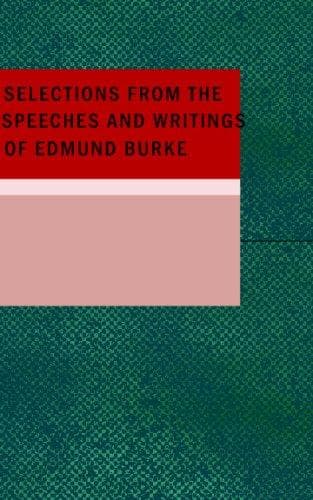
Selections from the Speeches and Writings of Edmund BurkeBurke, Edmund
Philosophy
Selections from the Speeches and Writings of Edmund Burke
Burke, Edmund
Burke, Edmund, 1729-1797; Essays; Political science; Speeches, addresses, etc.
On this their gaudy day the new regicide Directory sent for their
diplomatic rabble, as bad as themselves in principle, but infinitely
worse in degradation. They called them out by a sort of roll of their
nations, one after another, much in the manner in which they called
wretches out of their prison to the guillotine. When these ambassadors
of infamy appeared before them, the chief director, in the name of the
rest, treated each of them with a short, affected, pedantic, insolent,
theatric laconium: a sort of epigram of contempt. When they had thus
insulted them in a style and language which never before was heard, and
which no sovereign would for a moment endure from another, supposing any
of them frantic enough to use it; to finish their outrage, they drummed
and trumpeted the wretches out of their hall of audience.
Among the objects of this insolent buffoonery was a person supposed to
represent the king of Prussia. To this worthy representative they did
not so much as condescend to mention his master; they did not seem to
know that he had one; they addressed themselves solely to Prussia in
the abstract, notwithstanding the infinite obligation they owed to their
early protector for their first recognition and alliance, and for the
part of his territory he gave into their hands for the first-fruits of
his homage. None but dead monarchs are so much as mentioned by them, and
those only to insult the living by an invidious comparison. They told
the Prussians they ought to learn, after the example of Frederick the
Great, a love for France. What a pity it is, that he, who loved France
so well as to chastise it, was not now alive, by an unsparing use of
the rod (which indeed he would have spared little) to give them another
instance of his paternal affection. But the Directory were mistaken.
These are not days in which monarchs value themselves upon the title of
GREAT: they are grown PHILOSOPHIC: they are satisfied to be good. Your
lordship will pardon me for this no very long reflection on the short
but excellent speech of the plumed director to the ambassador of
Cappadocia. The imperial ambassador was not in waiting, but they found
for Austria a good Judean representation. With great judgment his
highness the Grand Duke had sent the most atheistic coxcomb to be found
in Florence to represent, at the bar of impiety, the house of apostolic
majesty, and the descendants of the pious, though high-minded, Maria
Theresa. He was sent to humble the whole race of Austria before those
grim assassins, reeking with the blood of the daughter of Maria Theresa,
whom they sent, half-dead, in a dung-cart, to a cruel execution; and
this true-born son of apostasy and infidelity, this renegado from the
faith, and from all honour and all humanity, drove an Austrian coach
over the stones which were yet wet with her blood;--with that blood
which dropped every step through her tumbril, all the way she was drawn
Public-domain text, read in full here on John Shaqi.
Reviews
Reviews
No reviews yet
Be the first to share your thoughts on this work.
Elsewhere in the archive
Join the Discussion
Join the discussion
Sign in to leave a comment or review.
Sign InorCreate an account