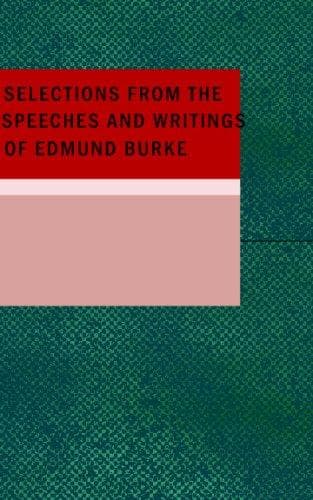
Selections from the Speeches and Writings of Edmund BurkeBurke, Edmund
Philosophy
Selections from the Speeches and Writings of Edmund Burke
Burke, Edmund
Burke, Edmund, 1729-1797; Essays; Political science; Speeches, addresses, etc.
The consecration of the state, by a state religious establishment,
is necessary also to operate with a wholesome awe upon free citizens;
because in order to secure their freedom, they must enjoy some
determinate portion of power. To them therefore a religion connected
with the state, and with their duty towards it, becomes even more
necessary than in such societies, where the people, by the terms of
their subjection, are confined to private sentiments, and the management
of their own family concerns. All persons possessing any portion of
power ought to be strongly and awfully impressed with an idea that they
act in trust; and that they are to account for their conduct in that
trust to the one great Master, Author, and Founder of society. This
principle ought even to be more strongly impressed upon the minds of
those who compose the collective sovereignty, than upon those of single
princes. Without instruments, these princes can do nothing. Whoever uses
instruments, in finding helps, finds also impediments. Their power is
therefore by no means complete; nor are they safe in extreme abuse. Such
persons, however elevated by flattery, arrogance, and self-opinion, must
be sensible that whether covered or not by positive law, in some way or
other they are accountable even here for the abuse of their trust.
If they are not cut off by a rebellion of their people, they may be
strangled by the very janissaries kept for their security against
all other rebellion. Thus we have seen the king of France sold by his
soldiers for an increase of pay. But where popular authority is absolute
and unrestrained, the people have an infinitely greater, because a far
better founded, confidence in their own power. They are themselves, in a
great measure, their own instruments. They are nearer to their objects.
Besides, they are less under responsibility to one of the greatest
controlling powers on earth, the sense of fame and estimation. The
share of infamy, that is likely to fall to the lot of each individual
in public acts, is small indeed; the operation of opinion being in
the inverse ratio to the number of those who abuse power. Their own
approbation of their own acts has to them the appearance of a public
judgment in their favour. A perfect democracy is therefore the most
shameless thing in the world. As it is the most shameless, it is also
the most fearless. No man apprehends in his person that he can be made
subject to punishment. Certainly the people at large never ought: for as
all punishments are for example towards the conservation of the people
at large, the people at large can never become the subject of punishment
by any human hand. (Quicquid multis peccatur inultum.) It is therefore
of infinite importance that they should not be suffered to imagine that
their will, any more than that of kings, is the standard of right and
wrong. They ought to be persuaded that they are full as little entitled,
Public-domain text, read in full here on John Shaqi.
Reviews
Reviews
No reviews yet
Be the first to share your thoughts on this work.
Elsewhere in the archive
Join the Discussion
Join the discussion
Sign in to leave a comment or review.
Sign InorCreate an account