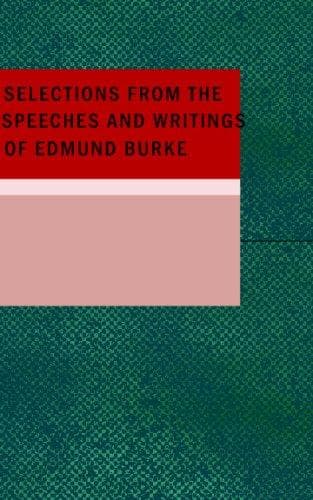
Selections from the Speeches and Writings of Edmund BurkeBurke, Edmund
Philosophy
Selections from the Speeches and Writings of Edmund Burke
Burke, Edmund
Burke, Edmund, 1729-1797; Essays; Political science; Speeches, addresses, etc.
But there is a time when men will not suffer bad things because their
ancestors have suffered worse. There is a time when the hoary head of
inveterate abuse will neither draw reverence nor obtain protection. If
the noble lord in the blue riband pleads "not guilty" to the charges
brought against the present system of public economy, it is not possible
to give a fair verdict by which he will not stand acquitted. But
pleading is not our present business. His plea or his traverse may be
allowed as an answer to a charge, when a charge is made. But if he
puts himself in the way to obstruct reformation, then the faults of
his office instantly become his own. Instead of a public officer in
an abusive department, whose province is an object to be regulated, he
becomes a criminal who is to be punished. I do most seriously put it
to administration, to consider the wisdom of a timely reform. Early
reformations are amicable arrangements with a friend in power;
late reformations are terms imposed upon a conquered enemy: early
reformations are made in cool blood; late reformations are made under
a state of inflammation. In that state of things people behold in
government nothing that is respectable. They see the abuse, and they
will see nothing else: they fall into the temper of a furious populace
provoked at the disorder of a house of ill-fame; they never attempt to
correct or regulate; they go to work by the shortest way--they abate the
nuisance, they pull down the house.
DIFFICULTIES OF REFORMERS.
Nothing, you know, is more common than for men to wish, and call loudly,
too, for a reformation, who, when it arrives, do by no means like the
severity of its aspect. Reformation is one of those pieces which must be
put at some distance in order to please. Its greatest favourers love it
better in the abstract than in the substance. When any old prejudice
of their own, or any interest that they value, is touched, they become
scrupulous, they become captious, and every man has his separate
exception. Some pluck out the black hairs, some the gray; one point must
be given up to one; another point must be yielded to another; nothing
is suffered to prevail upon its own principle; the whole is so frittered
down, and disjointed, that scarcely a trace of the original scheme
remains! Thus, between the resistance of power, and the unsystematical
process of popularity, the undertaker and the undertaking are both
exposed, and the poor reformer is hissed off the stage both by friends
and foes.
PHILOSOPHY OF COMMERCE.
Public-domain text, read in full here on John Shaqi.
Reviews
Reviews
No reviews yet
Be the first to share your thoughts on this work.
Elsewhere in the archive
Join the Discussion
Join the discussion
Sign in to leave a comment or review.
Sign InorCreate an account