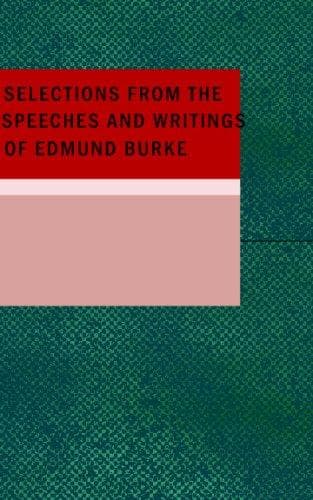
Selections from the Speeches and Writings of Edmund BurkeBurke, Edmund
Philosophy
Selections from the Speeches and Writings of Edmund Burke
Burke, Edmund
Burke, Edmund, 1729-1797; Essays; Political science; Speeches, addresses, etc.
Bad laws are the worst sort of tyranny. In such a country as this they
are of all bad things the worst, worse by far than anywhere else; and
they derive a particular malignity even from the wisdom and soundness of
the rest of our institutions. For very obvious reasons you cannot trust
the crown with a dispensing power over any of your laws. However,
a government, be it as bad as it may, will, in the exercise of a
discretionary power, discriminate times and persons; and will not
ordinarily pursue any man when its own safety is not concerned. A
mercenary informer knows no distinction. Under such a system, the
obnoxious people are slaves, not only to the government, but they live
at the mercy of every individual; they are at once the slaves of
the whole community, and of every part of it; and the worst and most
unmerciful men are those on whose goodness they most depend.
In this situation men not only shrink from the frowns of a stern
magistrate, but they are obliged to fly from their very species. The
seeds of destruction are sown in civil intercourse, in social habitudes.
The blood of wholesome kindred is infected. Their tables and beds are
surrounded with snares. All the means given by Providence to make
life safe and comfortable are perverted into instruments of terror and
torment. This species of universal subserviency, that makes the very
servant who waits behind your chair the arbiter of your life and
fortune, has such a tendency to degrade and abase mankind, and to
deprive them of that assured and liberal state of mind which alone can
make us what we ought to be, that I vow to God I would sooner bring
myself to put a man to immediate death for opinions I disliked, and so
to get rid of the man and his opinions at once, than to fret him with
a feverish being, tainted with the jail-distemper of a contagious
servitude, to keep him above ground an animated mass of putrefaction,
corrupted himself, and corrupting all about him.
FALSE REGRET.
If we repent of our good actions, what, I pray you, is left for our
faults and follies? It is not the beneficence of the laws, it is the
unnatural temper which beneficence can fret and sour that is to be
lamented. It is this temper which, by all rational means, ought to be
sweetened and corrected. If froward men should refuse this cure, can
they vitiate anything but themselves? Does evil so react upon good, as
not only to retard its motion, but to change its nature? If it can
so operate, then good men will always be in the power of the bad;
and virtue, by a dreadful reverse of order, must lie under perpetual
subjection and bondage to vice.
BRITISH DOMINION IN EAST INDIA.
With very few, and those inconsiderable, intervals, the British
dominion, either in the Company's name, or in the names of princes
absolutely dependent upon the Company, extends from the mountains that
separate India from Tartary to Cape Comorin,--that is, one-and-twenty
degrees of latitude!
Public-domain text, read in full here on John Shaqi.
Reviews
Reviews
No reviews yet
Be the first to share your thoughts on this work.
Elsewhere in the archive
Join the Discussion
Join the discussion
Sign in to leave a comment or review.
Sign InorCreate an account