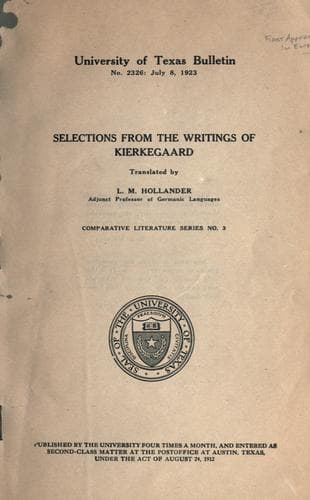
Selections from the Writings of KierkegaardKierkegaard, Søren
Religion
Selections from the Writings of Kierkegaard
Kierkegaard, Søren
Philosophy; Theology
It is the lowly Jesus Christ, a humble man, born of a maiden
of low degree, whose father is a carpenter. To be sure, his
appearance is made under conditions which are bound to attract
attention to him. The small nation among whom he appears, God's
Chosen People as they call themselves, live in anticipation of
a Messiah who is to bring a golden period to land and people.
You must grant that the form in which he appears is as different
as possible from what most people would have expected. On the
other hand, his appearance corresponds more to the ancient prophecies
with which the people are thought to have been familiar. Thus
he presents himself. A predecessor has called attention to him,
and he himself fastens attention very decidedly on himself by
signs and wonders which are noised abroad in all the land--and
he is the hero of the hour, surrounded by unnumbered multitudes
of people wheresoever he fares. The sensation aroused by him
is enormous, every one's eyes are fastened on him, every one
who can go about, aye even those who can only crawl, must see
the wonder--and every one must have some opinion about him,
so that the purveyors of ready-made opinions are put to it because
the demand is so furious and the contradictions so confusing.
And yet he, the worker of miracles, ever remains the humble man
who literally hath not where to lay his head.
And let us not forget: signs and wonders as contemporary events
have a markedly greater elasticity in repelling or attracting
than the tame stories generally re-hashed by the priests, or the
still tamer stories about signs and wonders that happened--1800
years ago! Signs and wonders as contemporary events are something
plaguy and importunate, something which in a highly embarrassing
manner almost compels one to have an opinion, something which,
if one does not happen to be disposed to believe, may exasperate
one excessively by thus forcing one to be contemporaneous with it.
Indeed, it renders existence too complicated, and the more so, the
more thoughtful, developed, and cultured one is. It is a peculiarly
ticklish matter, this having to assume that a man who is contemporaneous
with one really performs signs and wonders; but when he is at some
distance from one, when the consequences of his life stimulate
the imagination a bit, then it is not so hard to imagine, in a
fashion, that one believes it.
As I said, then, the people are carried away with him; they follow
him jubilantly, and see signs and wonders, both those which he
performs and those which he does not perform, and they are glad
in their hope that the golden age will begin, once he is king.
But the crowd rarely have a clear reason for their opinions, they
think one thing today and another tomorrow. Therefore the wise
and the critical will not at once participate. Let us see now
what the wise and the critical must think, so soon as the first
impression of astonishment and surprise has subsided.
Public-domain text, read in full here on John Shaqi.
Reviews
Reviews
No reviews yet
Be the first to share your thoughts on this work.
Elsewhere in the archive
Join the Discussion
Join the discussion
Sign in to leave a comment or review.
Sign InorCreate an account