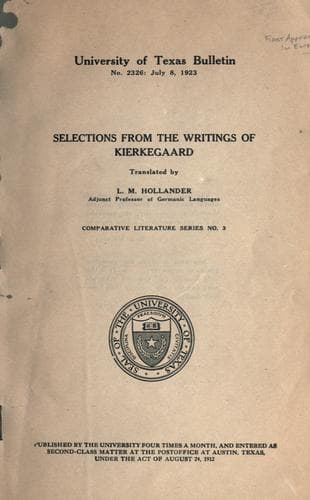
Selections from the Writings of KierkegaardKierkegaard, Søren
Religion
Selections from the Writings of Kierkegaard
Kierkegaard, Søren
Philosophy; Theology
And the steady citizen would reason as follows (which would
then become the opinion of his family): "Now, let us be human,
everything is good when done in moderation, too little and too
much spoil everything, and as a French saying has it which I
once heard a traveling salesman use: every power which exceeds
itself comes to a fall--and as to this person, his fall is certainly
sure enough. I have earnestly spoken to my son and warned and
admonished him not to drift into evil ways and join that person.
And why? Because all people are running after him. That is to
say, what sort of people? Idlers and loafers, street-walkers and
tramps, who run after everything. But mightily few of the men
who have house and property, and nobody who is wise and respected,
none after whom I set my clock, neither councillor Johnson, nor
senator Anderson, nor the wealthy broker Nelson--oh no! they
know what's what. And as to the ministry who ought to know most
about such matters--ah, they will have none of him. What was it
pastor Green said in the club the other evening? 'That man will
yet come to a terrible end,' he said. And Green, he can do more
than preach, you oughtn't to hear him Sundays in church so much
as Mondays in the club--I just wished I had half his knowledge
of affairs! He said quite correctly, and as if spoken out of
my own heart: 'Only idlers and loafers are running after that
man.' And why do they run after him? Because he performs some
miracles. But who is sure they are miracles, or that he can
confer the same power on his disciples? And, in any case, a
miracle is something mightily uncertain, whereas the certain
is the certain. Every serious father who has grown-up children
must be truly alarmed lest his sons be seduced and join that
man together with the desperate characters who follow him--desperate
characters who have nothing to lose. And even these, how does
he help them? Why, one must be mad to wish to be helped in this
fashion. Even the poorest beggar is brought to a worse estate
than his former one, is brought to a pass he could have escaped
by remaining what he was, that is, a beggar and no more."
Public-domain text, read in full here on John Shaqi.
Reviews
Reviews
No reviews yet
Be the first to share your thoughts on this work.
Elsewhere in the archive
Join the Discussion
Join the discussion
Sign in to leave a comment or review.
Sign InorCreate an account