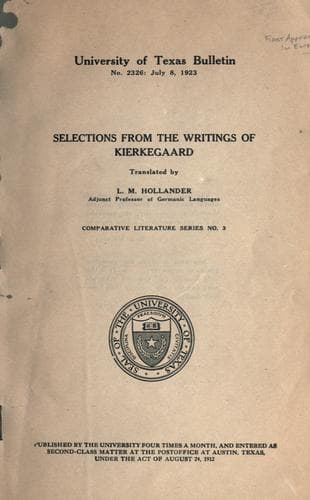
Selections from the Writings of KierkegaardKierkegaard, Søren
Religion
Selections from the Writings of Kierkegaard
Kierkegaard, Søren
Philosophy; Theology
Such, then, is his appearance; for take care not to be influenced
by anything that you may have learned after the event--as, how
his exalted spirit, with an almost divine majesty, never was
so markedly manifest as just them. Ah, my friend, if you were
the contemporary of one who is not only himself "excluded from
the synagogue" but, as you will remember, whose very help meant
being "excluded from the synagogue"--I say, if you were the
contemporary of an outcast, who in every respect answers to
that term, (for everything has two sides): then you will scarcely
be the man to explain all this in terms directly contrary to
appearances;[22] or, which is the same thing, you will not be
the "single individual" which, as you well know, no one wants
to be, and to be which is regarded as a ridiculous oddity, perhaps
even as a crime.
And now--for they are his society chiefly--as to his apostles!
What absurdity; though not--what new absurdity, for it is quite
in keeping with the rest--his apostles are some fishermen, ignorant
people who but the other day followed their trade. And tomorrow,
to pile one absurdity on the other, they are to go out into the
wide world and transform its aspect. And it is he who claims to
be God, and these are his duly appointed apostles! Now, is he to
make his apostles respected, or are perhaps the apostles to make
him respected? Is he, the inviter, is he an absurd dreamer?
Indeed, his procession would make it seem so; no poet could
have hit on a better idea. A teacher, a sage, or whatever you
please to call him, a kind of stranded genius, who affirms himself
to be God--surrounded by a jubilant mob, himself accompanied by
some publicans, criminals, and lepers; nearest to him a chosen
few, his apostles. And these judges so excellently competent as
to what truth is, these fishermen, tailors, and shoe-makers,
they do not only admire him, their teacher and master, whose
every word is wisdom and truth: they do not only see what no
one else can see, his exaltedness and holiness, nay, but they
see God in him and worship him. Certainly, no poet could invent
a better situation, and it is doubtful if the poet would not
forget the additional item that this same person is feared by
the mighty ones and that they are scheming to destroy him. His
death alone can reassure and satisfy them. They have set an
ignominious punishment on joining his company, on merely accepting
aid from him; and yet they do not feel secure, and cannot feel
altogether reassured that the whole thing is mere wrong-headed
enthusiasm and absurdity. Thus the mighty ones. The populace
who had Idolized him, the populace have pretty nearly given
him up, only in moments does their old conception of him blaze
forth again. In all his existence there is not a shred the most
envious of the envious might envy him to have. Nor do the mighty
ones envy his life. They demand his death for safety's sake, so
that they may have peace again, when all has returned to the
Public-domain text, read in full here on John Shaqi.
Reviews
Reviews
No reviews yet
Be the first to share your thoughts on this work.
Elsewhere in the archive
Join the Discussion
Join the discussion
Sign in to leave a comment or review.
Sign InorCreate an account