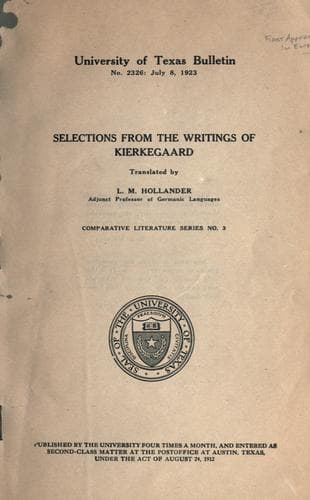
Selections from the Writings of KierkegaardKierkegaard, Søren
Religion
Selections from the Writings of Kierkegaard
Kierkegaard, Søren
Philosophy; Theology
Insofar, then, it was certain in advance what would be the inviter's
fate, even if nothing else had contributed to his doom. The
absolute,[23] or all which makes for an absolute standard, becomes
by that very fact the victim. For men are willing enough to
practice sympathy and self-denial, are willing enough to strive
for wisdom, etc.; but they wish themselves to determine the
standard and to have that read: "to a certain degree." They do
not wish to do away with all these splendid virtues. On the
contrary, they want--at a bargain and in all comfort--to have
the appearance and the name of practicing them. Truly divine
compassion is therefore necessarily the victim so soon as it
shows itself in this world. It descends on earth out of compassion
for mankind, and yet it is mankind who trample upon it. And
whilst it is wandering about among them, scarcely even the sufferer
dares to flee to it, for fear of mankind. The fact is, it is
most important for the world to keep up the appearance of being
compassionate; but this it made out by divine compassion to
be a falsehood--and therefore: away with divine compassion!
But now the inviter represented precisely this divine compassion--and
therefore he was sacrificed, and therefore even those that suffered
fled from him; for they comprehended (and, humanly speaking, very
exactly), what is true of most human infirmities, that one is better
off to remain what one is than to be helped by him.
In the second place: the inviter likewise had an other, and
altogether different, conception than the purely human one as
to what constitutes man's misery. And in this sense only he
was intent on helping; for he had with him neither money, nor
medicine, nor anything else of this kind.
Indeed, the inviter's appearance is so altogether different
from what human compassion wold imagine it that he is a downright
offense to men. In a purely human sense there is something positively
cruel--something outrageous, something so exasperating as to make
one wish to kill that person--in the fact of his inviting to
him the poor and the sick and the suffering, and then not being
able to do anything for them, except to promise them remission
of their sins. "Let us be human, man is no spirit. And when a
person is about to die of starvation and you say to him: I promise
you the gracious remission of your sins--that is revolting cruelty.
In fact it is ridiculous, though too serious a matter to laugh about."
Public-domain text, read in full here on John Shaqi.
Reviews
Reviews
No reviews yet
Be the first to share your thoughts on this work.
Elsewhere in the archive
Join the Discussion
Join the discussion
Sign in to leave a comment or review.
Sign InorCreate an account