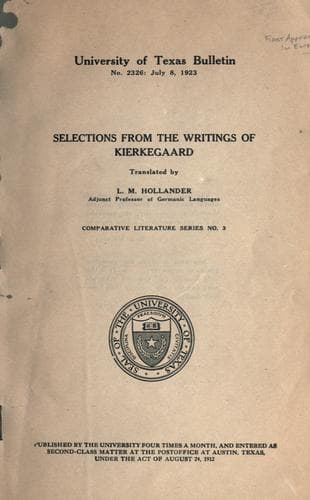
Selections from the Writings of KierkegaardKierkegaard, Søren
Religion
Selections from the Writings of Kierkegaard
Kierkegaard, Søren
Philosophy; Theology
That a man who in some fashion or other has what one calls a
"cause," something he seriously purposes to accomplish--and
there are other persons who make it their business to counteract,
and antagonize, and hurt him--that he must take measures against
these his enemies, this will be evident to every one. But that
there is a well-intentioned kindness by far more dangerous,
perhaps, and one that seems calculated to prevent the serious
accomplishment of his mission, this will not at once be clear
to every one.
When a person suddenly falls ill, kindly-intentioned folk will
straightway rush to his help, and one will suggest this, another
that--and if all those about him had a chance to have their way
it would certainly result in the sick man's death; seeing that
even one person's well-meaning advice may be dangerous enough.
And even if nothing is done, and the advice of neither the assembled
and well-meaning crowd nor of any one person is taken, yet their
busy and flurried presence may be harmful, nevertheless, inasmuch
as they are in the way of the physician.
Likewise at a fire. Scarcely has the alarm of fire been sounded
but a great crowd of people will rush to the spot, good and kindly
and sympathetic, helpful people, the one with a bucket, the other
with a basin, still another with a hand-squirt--all of them goodly,
kindly, sympathetic, helpful persons who want to do all they can
to extinguish the fire.
But what says the fire-marshal? The fire-marshal, he says--well,
at other times the fire-marshal is a very pleasant and refined
man; but at a fire he does use coarse language--he says or,
rather, he roars out: "Oh, go to hell with your buckets and
hand-squirts!" And then, when these well-meaning people feel
insulted, perhaps, and think it highly improper to be treated
in this fashion, and would like at least to be treated respectfully--what
says the fire-marshal then? Well, at other times the fire-marshal
is a very pleasant and refined gentleman who will show every
one the respect due him; but at a fire he is somewhat different--he
says: "Where the devil is the police?" And when the policemen
arrive he says to them: "Rid me of these damn people with their
buckets and hand-squirts; and if they won't clear out, then club
them on their heads, so that we get rid of them and--can get at
the fire!"
That is to say, in the case of a fire the whole way of looking
at things is a very different one from that of quiet every-day
life. The qualities which in quiet every-day life render one
well-liked, viz., good-nature and kindly well-meaning, all this
is repaid, in the case of a fire, with abusive language and
finally with a crack on the head.
Public-domain text, read in full here on John Shaqi.
Reviews
Reviews
No reviews yet
Be the first to share your thoughts on this work.
Elsewhere in the archive
Join the Discussion
Join the discussion
Sign in to leave a comment or review.
Sign InorCreate an account