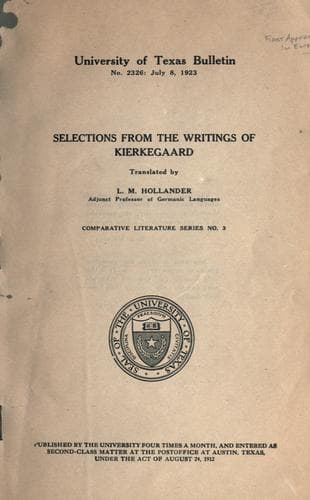
Selections from the Writings of KierkegaardKierkegaard, Søren
Religion
Selections from the Writings of Kierkegaard
Kierkegaard, Søren
Philosophy; Theology
In a Christian sense one ought to say: precisely the fact that
a priest is in it, precisely that is the worst thing about the
whole business. If you want to be married you ought, rather,
be married by a smith; for then--if it were admissible to speak
in this fashion--then it might possibly escape God's attention;
whereas, if there is a priest along it can certainly not escape
His attention. Precisely the fact of the clergyman's being there
makes it as criminal an affair as possible--call to mind what
was said to a man who in a storm at sea invoked the gods: "By
all means do not let the gods notice that you are aboard!" Thus
one might say here also: By all means try to avoid calling in
a priest. The others, the smith and the lovers, have not pledged
themselves by an oath on the New Testament, so matters are not
as bad--if it be admissible to speak in this fashion--as when
the priest assists with his--holy presence.
AN ETERNITY TO REPENT IN!
(No. VIII, 3)
Let me relate a story. I did not read it in a book of devotion
but in what is generally called light reading. Yet I do not
hesitate to make use of it, and indicate its source only lest
any one be disturbed if he should happen to be acquainted with
it, or find out at some later time where it is from--lest he be
disturbed that I had been silent about this.
Once upon a time there lived somewhere in the East a poor old
couple. Utterly poor they were, and anxiety about the future
naturally grew when they thought of old age approaching. They
did not, indeed, constantly assail heaven with their prayers,
they were too God-fearing to do that; but still they were ever
praying to God for help.
Then one morning it happened that the old woman found an exceeding
large jewel on the hearth-stone, which she forthwith showed to
her husband, who recognized its value and easily perceived that
now their poverty was at an end.
What a bright future for these old people, and what gladness!
But frugal and pious as they were they decided not to sell the
jewel just yet, since they had enough wherewithal to live still
one more day. But on the morrow they would sell it, and then a
new life was to begin for them.
In the following night the woman dreamed that she was transported
to Paradise. An angel showed her about the splendors which only
an Oriental imagination can devise. He showed her a hall in which
there stood long rows of arm-chairs gemmed all over with precious
stones and pearls. These, so the angel explained, were the seats
of the pious. And last of all he pointed out to her the one
destined for herself. When regarding it more closely she discovered
that a very large jewel was lacking in the back of the chair, and
she asked the angel how that might be. He--ah, watch now, for
here is the point! The angel answered: "That was the jewel which
you found on your hearth-stone. It was given you ahead of time,
and it cannot be put in again."
Public-domain text, read in full here on John Shaqi.
Reviews
Reviews
No reviews yet
Be the first to share your thoughts on this work.
Elsewhere in the archive
Join the Discussion
Join the discussion
Sign in to leave a comment or review.
Sign InorCreate an account