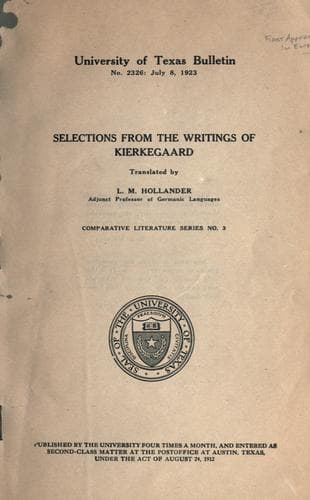
Selections from the Writings of KierkegaardKierkegaard, Søren
Religion
Selections from the Writings of Kierkegaard
Kierkegaard, Søren
Philosophy; Theology
God Incarnate is betrayed, mocked, deserted by absolutely all
men; not a single one, literally not a single one, remains faithful
to him--and then, afterwards, afterwards,--oh yes, afterwards,
there were millions of men who on their knees made pilgrimage
to the places where many hundred years ago His feet, perhaps,
trod the ground; afterwards, afterwards--oh yes, afterwards,
millions worshipped a splinter of the cross on which He was crucified!
And so it was always when men were contemporary with the great;
but afterwards, afterwards--oh yes, afterwards!
Must one then not loathe being human?
And again, must one not loathe being human? For these millions
who on their knees made pilgrimage to His grave, this throng of
people which no power on earth was able to overcome: but one
thing were necessary, Christ's return--and all these millions
would quickly regain their feet to run their way, so that the
whole throng were as if blown away; or would, in a mass, and
erect enough, rush upon Christ in order to kill him.
That which Christ and the Apostles and every martyr desires,
and desires as the only thing: that we should follow in His
footsteps, just that is the thing which mankind does not like
or does not find pleasure in.
No, take away the danger--so that it is but play, and then the
battallions of the human race will (ah, disgusting!) will perform
astonishing feats in aping Him; and then instead of an imitation
of Christ we get (ah, disgusting!), we get that sacred buffoonery--under
guidance and command (ah, disgusting!) of sworn clergymen who do
service as sergeants, lieutenants, etc.--ordained men who therefore
have the Holy Spirit's special assistance in this serious business.
[Footnote 1: Selections.]
[Footnote 2: The following sentence is not clear in the original.]
[Footnote 3: Matthew 7, 14.]
[Footnote 4: Luke 18, 8.]
[Footnote 5: The last line of this piece of bloody irony is not clear
in the original (S. V. XIII, 128). It will make better sense if one
substitutes "da" for the first "de."]
[Footnote 6: This suggestion had actually been made to Kierkegaard in the
course of his attacks on Martensen.]
[Footnote 7: Allusion to Psalm 56, 9; also, to a passage in one of Bishop
Mynster's sermons (S. V.).]
[Footnote 8: Either-or; either Cæsar or nothing (Cesare Borgia's slogan).]
[Footnote 9: "John 20, 19--where the disciples were assembled for
fear of the Jews, came Jesus and stood in the midst, and saith unto
them. Peace be unto you."]
[Footnote 10: This was, until very recently, the universal rule in
Protestant Scandinavia and Germany.]
[Footnote 11: It is to be borne in mind that Danish _videnskab_, like
German _Wissenschaft_, embraces the humanities and theology as well.]
[Footnote 12: I Cor. 7, 9.]
End of the Project Gutenberg EBook of Selections from the Writings of
Kierkegaard, by Søren Kierkegaard
Public-domain text, read in full here on John Shaqi.
Reviews
Reviews
No reviews yet
Be the first to share your thoughts on this work.
Elsewhere in the archive
Join the Discussion
Join the discussion
Sign in to leave a comment or review.
Sign InorCreate an account