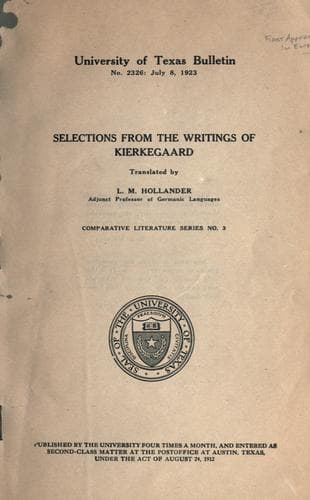
Selections from the Writings of Kierkegaard — John Shaqi
Selections from the Writings of KierkegaardKierkegaard, Søren
Religion
Selections from the Writings of Kierkegaard
Kierkegaard, Søren
Philosophy; Theology
Who is able to grasp this? And yet that which for the initiates of
love constitutes the greatest pleasure is also the most important thing
for them--so important that they even adopt new names, derived
from the consequence thereof which thus, curiously enough, assumes
retroactive force. The lover is now called father, his sweetheart,
mother; and these names seem to them the most beautiful. And yet there
is a being to whom these names are even more beautiful; for what is as
beautiful as filial piety? To me it seems the most beautiful of all
sentiments; and fortunately I can appreciate the thought underlying it.
We are taught that it is seeming in a son to love his father. This I
comprehend, I cannot even suspect that there is any contradiction
possible here, and I acknowledge infinite satisfaction in being held
by the loving bonds of filial piety. I believe it is the greatest debt
of all to owe another being one's life. I believe that this debt cannot
ever be wiped out, or even fathomed by any calculation, and for this
reason I agree with Cicero when he asserts that the son is always in the
wrong as against his father; and it is precisely filial piety which
teaches me to believe this, teaches me not even to penetrate the hidden,
but rather to remain hidden in the father. Quite true, I am glad to be
another person's greatest debtor; but as to the opposite, viz., before
deciding to make another person my greatest debtor, I want to arrive
at greater clarity. For to my conception there is a world of difference
between being some person's debtor, and making some person one's
debtor to such an extent that he will never be able to clear himself.
What filial piety forbids the son to consider, love bids the father
to consider. And here contradiction sets in again. If the son has an
immortal soul like his father, what does it mean, then, to be a father?
For must I not smile at myself when thinking of myself as a
father--whereas the son is most deeply moved when he reflects on
the relation he bears to his father? Very well do I understand Plato
when he says that an animal will give birth to an animal of the same
species, a plant, to a plant of the same species, and thus also man
to man.[22] But this explains nothing, does not satisfy one's thought,
and arouses but a dim feeling; for an immortal soul cannot be born.
Whenever, then, a father considers his son in the light of his son's
immortality--which is, indeed, the essential consideration[23]--he
will probably smile at himself, for he cannot, by any means, grasp in
their entirety all the beautiful and noble thoughts which his son with
filial piety entertains about him. If, on the other hand, he considers
his son from the point of view of his animal nature he must smile again,
because the conception of fatherhood is too exalted an expression
for it.
Public-domain text, read in full here on John Shaqi.
Reviews
Reviews
No reviews yet
Be the first to share your thoughts on this work.
Join the Discussion
Join the discussion
Sign in to leave a comment or review.
Sign InorCreate an account