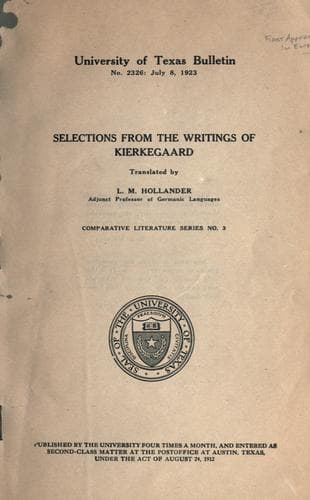
Selections from the Writings of KierkegaardKierkegaard, Søren
Religion
Selections from the Writings of Kierkegaard
Kierkegaard, Søren
Philosophy; Theology
The resulting confusion is capital, if one but is attentive and
does not forget. A dead man is one of the most amusing characters
to be met with in life. Strange that more use is not made of
him on the stage, for in life he is seen, now and then. When you come
to think of it, even one who has only been seemingly dead is a comical
figure; but one who was really dead certainly contributes to our
entertainment all one can reasonably expect of a man. All depends
on whether one is attentive. I myself had my attention called to it,
one day, as I was walking with one of my acquaintances. A couple
passed us. I judged from the expression on his face that he knew them
and asked whether that was the case. "Why, yes," he answered, "I know
them very well, and especially the lady, for she is my departed
one."--"What departed one?" I asked.--"Why, my departed first
love," he answered. "Indeed, this is a strange affair. She said:
I shall die. And that very same moment she departed, naturally enough,
by death--else one might have insured her beforehand in the
widow's insurance. Too late! Dead she was and dead she remained;
and now I wander about, as says the poet, vainly seeking the grave of
my lady-love that I may shed my tears thereon." Thus this broken-hearted
man who remained alone in the world, though it consoled him to find
her pretty far along with some other man.
It is a good thing for the girls, thought I, that they don't have to
be buried, every time they die; for if parents have hitherto considered
a boy-child to be the more expensive, the girls might become even
more so!
A simple case of infidelity is not as amusing, by far. I mean, if a
girl should fall in love with some one else and should say to her lover:
"I cannot help it, save me from myself!" But to die from sorrow because
she cannot endure being separated from her lover by his journey to the
West Indies, to have put up with his departure, however,--and
then, at his return, be not only not dead, but attached to some one
else for all time--that certainly is a strange fate for a lover to
undergo. No wonder, then, that the heart-broken man at times consoled
himself with the burthen of an old song which runs: "Hurrah for you and
me, I say, we never shall forget that day!"
Public-domain text, read in full here on John Shaqi.
Reviews
Reviews
No reviews yet
Be the first to share your thoughts on this work.
Elsewhere in the archive
Join the Discussion
Join the discussion
Sign in to leave a comment or review.
Sign InorCreate an account