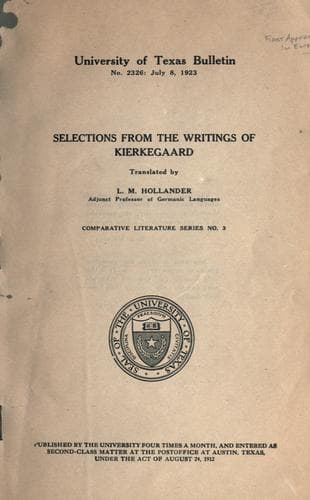
Selections from the Writings of KierkegaardKierkegaard, Søren
Religion
Selections from the Writings of Kierkegaard
Kierkegaard, Søren
Philosophy; Theology
Now forgive me, dear fellow-banqueters, if I have spoken at too
great length; and empty a glass to love and to woman. Beautiful she
is and lovely, if she be considered æsthetically. That is undeniable.
But, as has often been said, and as I shall say also: one ought not to
remain standing here, but should go on.[36] Consider her, then,
ethically and you will hardly have begun to do so before the humor
of it will become apparent. Even Plato and Aristotle assume that
woman is an imperfect form, an irrational quantity, that is, one
which might some time, in a better world, be transformed into a
man. In this life one must take her as she is. And what this is becomes
apparent very soon; for she will not be content with the æsthetic
sphere, but goes on, she wants to become emancipated, and she has the
courage to say so. Let her wish be fulfilled and the amusement will be
simply incomparable.
When Constantin had finished speaking he forthwith ruled Victor
Eremita to begin. He spoke as follows:
(Victor Eremita's Speech)
As will be remembered, Plato offers thanks to the gods for four
things. In the fourth place he is grateful for having been permitted
to be a contemporary of Socrates. For the three other boons mentioned
by him,[37] an earlier Greek philosopher[38] had already thanked
the gods, and so I conclude that they are worthy our gratitude. But
alas!--even if I wanted to express my gratitude like these Greeks I
would not be able to do so for what was denied me. Let me then
collect my soul in gratitude for the one good which was conferred
on me also--that I was made a man and not a woman.
To be a woman is something so curious, so heterogeneous and
composite that no predicate will fully express these qualities;
and if I should use many predicates they would contradict one
another in such fashion that only a woman would be able to tolerate
the result and, what is worse, feel happy about it. The fact that
she really signifies less than man--that is not her misfortune,
and still less so if she got to know it, for it might be borne
with fortitude. No, her misfortune consists in her life's having
become devoid of fixed meaning through a romantic conception of
things, by virtue of which, now she signifies all, and now, nothing at
all; without ever finding out what she really does signify--and
even that is not her misfortune but, rather, the fact that, being
a woman, she never will be able to find out. As for myself, if I
were a woman, I should prefer to be one in the Orient and as a
slave; for to be a slave, neither more nor less, is at any rate
something, in comparison with being, now heyday, now nothing.
Public-domain text, read in full here on John Shaqi.
Reviews
Reviews
No reviews yet
Be the first to share your thoughts on this work.
Elsewhere in the archive
Join the Discussion
Join the discussion
Sign in to leave a comment or review.
Sign InorCreate an account