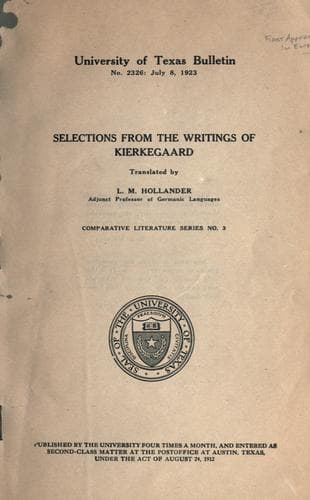
Selections from the Writings of KierkegaardKierkegaard, Søren
Religion
Selections from the Writings of Kierkegaard
Kierkegaard, Søren
Philosophy; Theology
Even if a woman's life did not contain such contrasts, the distinction
she enjoys, and which is rightly assumed to be hers as a woman--a
distinction she does not share with man--would by itself point to
the meaninglessness of her life. The distinction I refer to is
that of gallantry. To be gallant to woman is becoming in men. Now
gallantry consists very simply in conceiving in fantastic categories
that person to whom one is gallant. To be gallant to a man is,
therefore, an insult, for he begs to be excused from the application
of fantastic categories to him. For the fair sex, however, gallantry
signifies a tribute, a distinction, which is essentially its
privilege. Ah me, if only a single cavalier were gallant to them
the case would not be so serious. But far from it! At bottom every
man is gallant, he is unconsciously so. This signifies, therefore,
that it is life itself which has bestowed this perquisite on the
fair sex. Woman on her part unconsciously accepts it. Here we have
the same trouble again; for if only a single woman did so, another
explanation would be necessary. This is life's characteristic irony.
Now if gallantry contained the truth it ought to be reciprocal,
i.e., gallantry would be the accepted quotation for the stated
difference between beauty on the one hand, and power, astuteness,
and strength, on the other. But this is not the case, gallantry
is essentially woman's due; and the fact that she unconsciously
accepts it may be explained through the solicitude of nature
for the weak and those treated in a step-motherly fashion by her,
who feel more than recompensed by an illusion. But precisely this
illusion is her misfortune. It is not seldom the case that nature
comes to the assistance of an afflicted creature by consoling him
with the notion that he is the most beautiful. If that is so, why,
then we may say that nature made good the deficiency since now
the creature is endowed with even more than could be reasonably
demanded. But to be beautiful only in one's imagination, and not
to be overcome, indeed, by sadness, but to be fooled into an
illusion--why, that is still worse mockery. Now, as to being
afflicted, woman certainly is far from having been treated in a
step-motherly fashion by nature; still she is so in another sense
inasmuch as she never can free herself from the illusion with which
life has consoled her.
Public-domain text, read in full here on John Shaqi.
Reviews
Reviews
No reviews yet
Be the first to share your thoughts on this work.
Elsewhere in the archive
Join the Discussion
Join the discussion
Sign in to leave a comment or review.
Sign InorCreate an account