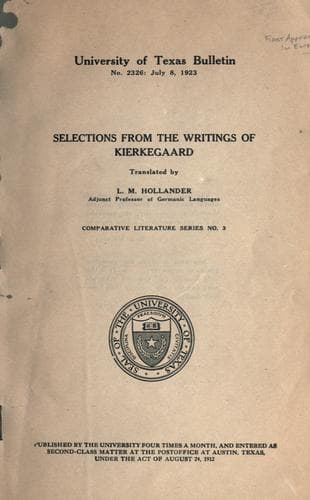
Selections from the Writings of KierkegaardKierkegaard, Søren
Religion
Selections from the Writings of Kierkegaard
Kierkegaard, Søren
Philosophy; Theology
Woman's main significance lies in her negative contribution,
whereas her positive contributions are as nothing in comparison
but, on the contrary, pernicious. It is this truth which life keeps
from her, consoling her with an illusion which surpasses all that
might arise in any man's brain, and with parental care ordering
life in such fashion that both language and everything else confirm
her in her illusion. For even if she be conceived as the very opposite
of inspiring, and rather as the well-spring of all corruption;
whether now we imagine that with her, sin came into the world, or
that it is her infidelity which ruined all--our conception of her
is always gallant. That is, when hearing such opinions one might
readily assume that woman were really able to become infinitely
more culpable than man, which would, indeed, amount to an immense
acknowledgment of her powers. Alas, alas! the case is entirely
different. There is a secret reading of this text which woman
cannot comprehend; for, the very next moment, all life owns to the
same conception as the state, which makes man responsible for his
wife. One condemns her as man never is condemned (for only a real
sentence is passed on him, and there the matter ends), not with
her receiving a milder sentence; for in that case not all of her
life would be an illusion, but with the case against her being
dismissed and the public, i.e., life, having to defray the costs.
One moment, woman is supposed to be possessed of all possible
wiles, the next moment, one laughs at him whom she deceived, which
surely is a contradiction. Even such a case as that of Potiphar's
wife does not preclude the possibility of her having really been
seduced. Thus has woman an enormous possibility, such as no man
has--an enormous possibility; but her reality is in proportion.
And most terrible of all is the magic of illusion in which she
feels herself happy.
Let Plato then thank the gods for having been born a contemporary
of Socrates: I envy him; let him offer thanks for being a Greek:
I envy him; but when he is grateful for having been born a man
and not a woman I join him with all my heart. If I had been born
a woman and could under stand what now I can understand--it were
terrible! But if I had been born a woman and therefore could not
understand it--that were still more terrible!
But if the case is as I stated it, then it follows that one had
better refrain from any positive relation with woman. Wherever she
is concerned one has to reckon with that inevitable hiatus which
renders her happy as she does not detect the illusion, but which
would be a man's undoing if he detected it.
I thank the gods, then, that I was born a man and not a woman;
and I thank them, furthermore, that no woman by some life-long
attachment holds me in duty bound to be constantly reflecting
that it ought not to have been.
Public-domain text, read in full here on John Shaqi.
Reviews
Reviews
No reviews yet
Be the first to share your thoughts on this work.
Elsewhere in the archive
Join the Discussion
Join the discussion
Sign in to leave a comment or review.
Sign InorCreate an account