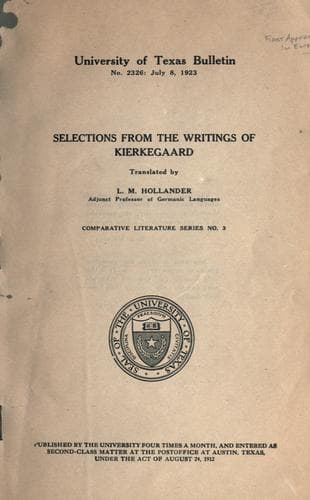
Selections from the Writings of KierkegaardKierkegaard, Søren
Religion
Selections from the Writings of Kierkegaard
Kierkegaard, Søren
Philosophy; Theology
sun shines in all his summer glory one thinks straightway that
there must be some festal occasion at hand--that it cannot be
so for every-day use, or that it is the first time, or at least
one of the first times; for surely, one thinks, it cannot be
repeated for any length of time. Thus would think he who saw
it but once, or saw it for the first time; and I saw the wife
of the justice for the first time. He who sees the object in
question every day may think differently; provided he sees the
same thing. But let the judge decide about that!
As I remarked, our amiable housewife was occupied. She poured
boiling water into the cups, probably to warm them, emptied them
again, set a cup on a platter, poured the tea and served it with
sugar and cream--now all was ready; was it fun or earnest? In
case a person did not relish tea at other times--he should have
sat in the judge's place; for just then that drink seemed most
inviting to me, only the inviting air of the lovely woman herself
seemed to me more inviting.
It appeared that she had not had time to speak until then. Now
she broke the silence and said, while serving him his tea: "Quick,
now, dear, and drink while it is hot, the morning air is quite
cool, anyway; and surely the least I can do for you is to be a
little careful of you. The least?" the judge answered laconically.
"Yes, or the most, or the only thing." The judge looked at her
inquiringly, and whilst he was helping himself she continued: "You
interrupted me yesterday when I wished to broach the subject, but
I have thought about it again; many times I have thought about
it, and now particularly, you know yourself in reference to
whom: it is certainly true that if you hadn't married, you would
have been far more successful in your career." With his cup still
on the platter the judge sipped a first mouthful with visible
enjoyment, thoroughly refreshed; or was it perchance the joy
over his lovely wife; I for my part believe it was the latter.
She, however, seemed only to be glad that it tasted so good to
him. Then he put down his cup on the table at his side, took out
a cigar, and said: "May I light it at your chafing-dish"? "Certainly,"
she said, and handed him a live coal on a tea-spoon. He lit his
cigar and put his arm about her waist whilst she leaned against
his shoulder. He turned his head the other way to blow out the
smoke, and then he let his eyes rest on her with a devotion such
as only a glance can reveal; yet he smiled, but this glad smile
had in it a dash of sad irony. Finally he said: "Do you really
believe so, my girl? What do you mean?" she answered. He was
silent again, his smile gained the upper hand, but his voice
remained quite serious, nevertheless. "Then I pardon you your
previous folly, seeing that you yourself have forgotten it so
quickly; thou speakest as one of the foolish women speaketh[57]--what
great career should I have had?" His wife seemed embarrassed
Public-domain text, read in full here on John Shaqi.
Reviews
Reviews
No reviews yet
Be the first to share your thoughts on this work.
Elsewhere in the archive
Join the Discussion
Join the discussion
Sign in to leave a comment or review.
Sign InorCreate an account