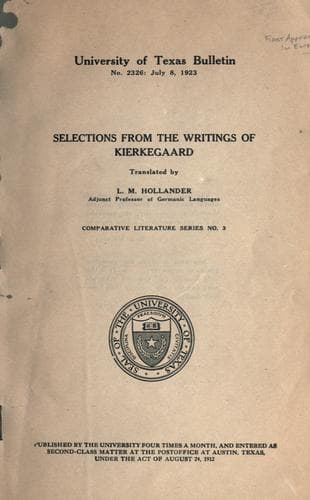
Selections from the Writings of KierkegaardKierkegaard, Søren
Religion
Selections from the Writings of Kierkegaard
Kierkegaard, Søren
Philosophy; Theology
But who, then, am I? Let no one ask! If it hasn't occurred to you
before to ask about it I am over the difficulty; for now the worst
is behind me. For that matter, I am not worth asking about, for
I am the least of all things, people would put me in utter confusion
by asking about me. I am pure existence, and therefore smaller,
almost, than nothing. I am "pure existence" which is present
everywhere but still is never noticed; for I am ever vanishing.
I am like the line above which stands the summa summarum--who
cares about the line? By my own strength I can accomplish nothing,
for even the idea to steal the manuscript from Victor was not my
own idea; for this very idea which, as a thief would say, induced
me to "borrow" the manuscript, was borrowed from him. And now,
when editing this manuscript, I am, again, nothing at all; for
it rightly belongs to the judge. And as editor, I am in my nothingness
only a kind of nemesis on Victor, who imagined that he had the
prescriptive right to do so.
[Footnote 1: _Cf._ Luke XIV, 19-20.]
[Footnote 2: Words used in the banns.]
[Footnote 3: Which in Latin means both "from the temple" and "at once."]
[Footnote 4: The omission of the negative particle in the original is
no doubt unintentional.]
[Footnote 5: Pious wish.]
[Footnote 6: Kings 20, 1; Isaiah 38, 1.]
[Footnote 7: An allusion to the plight of Aristophanes in Plato's
_Symposion._]
[Footnote 8: Haggai 1, 6 (inexact).]
[Footnote 9: May it be fortunate and favorable.]
[Footnote 10: _Symposion_, ch. 9.]
[Footnote 11: This ironic sally refers, not to Descartes' principle
of skepsis, but to the numerous Danish followers of Hegel and his
"method"; _cf._ Fear and Trembling.]
[Footnote 12: _Symposion_, ch. 24.]
[Footnote 13: _Ibid._, ch. 15-16.]
[Footnote 14: _Cf._ Matthew 13, 31 etc.]
[Footnote 15: A quotation from Musæus, _Volksmärchen der Deutschen_,
III, 219.]
[Footnote 16: The reference is to a situation in Richard Cumberland's
(1732-1811) play of "The Jew," known to Copenhagen playgoers in an
adaptation.]
[Footnote 17: I relate what I have been told.]
[Footnote 18: A character in the Danish playwright Overskou's vaudeville
of "Capriciosa" (Comedies III, 184).]
[Footnote 19: The glutton in Oehlenschlœger's vaudeville of
"Sovedrikken."]
[Footnote 20: Supplied by the translator to complete the sense.]
[Footnote 21: Dejection. _Cf._ the maxim: _omne animal post coïtun
triste._]
[Footnote 22: This statement is to be found, rather, in Aristotle's
Ethics II, 6.]
[Footnote 23: There is a pun here in the original.]
[Footnote 24: In Holberg's comedy of "Erasmus Montanus," III, 6.]
[Footnote 25: _Cf._ "The Banquet."]
[Footnote 26: "Eccles, 3, 7."]
[Footnote 27: "Comical power."]
[Footnote 28: "In uncertain battle."]
[Footnote 29: According to the development of these terms in Kierkegaard's
previous works, the "absolute" belongs to the ethic, the "relative"
to the æsthetic sphere.]
[Footnote 30: Heroine of Mozart's "Don Juan."]
Public-domain text, read in full here on John Shaqi.
Reviews
Reviews
No reviews yet
Be the first to share your thoughts on this work.
Elsewhere in the archive
Join the Discussion
Join the discussion
Sign in to leave a comment or review.
Sign InorCreate an account