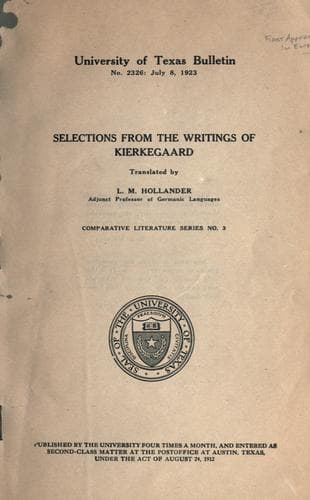
Selections from the Writings of KierkegaardKierkegaard, Søren
Religion
Selections from the Writings of Kierkegaard
Kierkegaard, Søren
Philosophy; Theology
It was in the early morning, Abraham arose betimes and had his
asses saddled. He departed from his tent, and Isaac with him;
but Sarah looked out of the window after them until they were
out of sight. Silently they rode for three days; but on the fourth
morning Abraham said not a word but lifted up his eyes and beheld
Mount Moriah in the distance. He left his servants behind and,
leading Isaac by the hand, he approached the mountain. But Abraham
said to himself: "I shall surely conceal from Isaac whither he is
going." He stood still, he laid his hand on Isaac's head to bless
him, and Isaac bowed down to receive his blessing. And Abraham's
aspect was fatherly, his glance was mild, his speech admonishing.
But Isaac understood him not, his soul would not rise to him; he
embraced Abraham's knees, he besought him at his feet, he begged
for his young life, for his beautiful hopes, he recalled the joy
in Abraham's house when he was born, he reminded him of the sorrow
and the loneliness that would be after him. Then did Abraham raise
up the youth and lead him by his hand, and his words were full of
consolation and admonishment. But Isaac understood him not. He
ascended Mount Moriah, but Isaac understood him not. Then Abraham
averted his face for a moment; but when Isaac looked again, his
father's countenance was changed, his glance wild, his aspect
terrible, he seized Isaac and threw him to the ground and said:
"Thou foolish lad, believest thou I am thy father? An idol-worshipper
am I. Believest thou it is God's command? Nay, but my pleasure."
Then Isaac trembled and cried out in his fear: "God in heaven,
have pity on me, God of Abraham, show mercy to me, I have no
father on earth, be thou then my father!" But Abraham said softly
to himself: "Father in heaven, I thank thee. Better is it that
he believes me inhuman than that he should lose his faith in thee."
When the child is to be weaned, his mother blackens her breast;
for it were a pity if her breast should look sweet to him when he
is not to have it. Then the child believes that her breast has
changed; but his mother is ever the same, her glance is full of love
and as tender as ever. Happy he who needed not worse means to wean
his child!
II
Public-domain text, read in full here on John Shaqi.
Reviews
Reviews
No reviews yet
Be the first to share your thoughts on this work.
Elsewhere in the archive
Join the Discussion
Join the discussion
Sign in to leave a comment or review.
Sign InorCreate an account