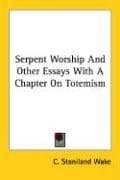
Serpent-Worship, and Other Essays, with a Chapter on TotemismWake, C. Staniland (Charles Staniland)
Religion
Serpent-Worship, and Other Essays, with a Chapter on Totemism
Wake, C. Staniland (Charles Staniland)
Phallicism; Serpent worship; Totemism
It can hardly be doubted that the most civilised races, of which we
may call the modern world, have, with the exception of the Chinese,
belonged to the two great branches of the Caucasian stock, the
Aryan and the Semitic-speaking peoples. Those races, and especially
such of them as inhabit the Western part of the Old Continent, have
shown a preference for monogamy or polygamy, the former being almost
restricted to Europeans, the latter being nearly universal among the
Asiatic portion of the Caucasian stock. The inferior races, however,
possess the least advanced systems of marriage. The natives of the
Australian Continent are usually regarded as the most uncivilised of
mankind, and among them there has been developed a system which some
persons would probably consider not entitled to the name of marriage.
In it individuals give place theoretically to groups, between whom
the marriage relation is supposed to be formed, the individuals being
treated only as members of a group. The existence of this peculiar
system has been established by the inquiries of the Rev. Lorimer Fison,
who has shown, moreover, that Australian marriage “is something
more than the marriage of group to group, _within a tribe_. It is
an arrangement, extending across a Continent, which divides many
widely-scattered tribes into intermarrying classes, and gives a man
of one class marital rites over women of another class in a tribe a
thousand miles away, and speaking a language other than his own. It
seems to be strong evidence of the common origin of all the Australian
tribes among whom it prevails; and it is a striking illustration of how
custom remains fixed while language changes.”[238] An American writer,
Mr. Lewis Morgan, who was the first to point out the prevalence among
the less cultured races of mankind of relationship which he terms
“_classificatory_,” in opposition to the _descriptive_ relationships
of the superior races, states that, according to Australian marriage,
“a group of males distinguished by the same class name are the born
husbands of a group of females bearing another class name; and
whenever a male of this class meets a female of the other class, they
recognise each other as husband and wife, and their right to live in
this relation is regarded by the tribe to which they belong.” The
peculiarity of this system is, not that each individual is entitled
to take a wife or husband out of a particular group, but that, in
theory, every individual is from birth the husband or wife of all the
members of a special group. Mr. Fison remarks further that the idea
of marriage under that system is founded on the rights neither of the
woman nor of the man. It is based “on the rights of the tribe, or
rather of the classes into which the tribe is divided. Class marriage
is not a contract entered into by two parties. It is a natural state
into which both parties are born, and they have to be content with
Public-domain text, read in full here on John Shaqi.
Reviews
Reviews
No reviews yet
Be the first to share your thoughts on this work.
Elsewhere in the archive
Join the Discussion
Join the discussion
Sign in to leave a comment or review.
Sign InorCreate an account