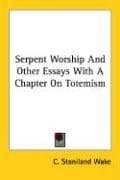
Serpent-Worship, and Other Essays, with a Chapter on TotemismWake, C. Staniland (Charles Staniland)
Religion
Serpent-Worship, and Other Essays, with a Chapter on Totemism
Wake, C. Staniland (Charles Staniland)
Phallicism; Serpent worship; Totemism
which is due to the fact that relationship is conceived, not between
individual and individual, but between group and group. Extraordinary
as is the Australian system at the present time, when each class, or
intermarrying group, embraces so many individuals, it would not appear
so strange if, as was originally the case, each group consisted only of
the immediate descendants of the common female ancestor. In this case
all the males in any particular generation of each family group would
be the husbands of all the females in the same generation of the other
family; in other words, all the men of each group would have their
wives in common and all the women their husbands in common. Moreover,
the actual practice of the Australian tribes differs from the theory.
Every man and every woman is permanently married to an individual of
the opposite sex, and often this connection is formed at an early
age by arrangement between the parents of the persons concerned. In
addition, however, each of these persons may be allotted by the great
council of the tribe as an “accessory spouse,” or _pirauru_, to some
other individual. The Australian system, therefore, presents a mixture
of individual marriage and group marriage, the latter of which is
evidently closely connected with the right of sexual hospitality, which
is considered by the savage mind as natural and of great importance.
Australian marriage is thus based on what may be theoretically termed
the natural marriage between two groups of individuals whose wishes are
never consulted in the matter. The same arrangement might, of course,
be made among the individuals themselves, and, curiously enough, a form
of group marriage, much restricted in its operation, was at one time
fully recognised among the Polynesian Islands of the Pacific. This
system was known as _punalua_, and it consisted in two or more brothers
having their wives, or two or more sisters having their husbands, in
common. Here, brothers and sisters form one group, and the wives of
the one with the husbands of the other, themselves being brothers
and sisters (actual or tribal), form another group answering to the
intermarrying classes of the Australians. The Polynesian _punalua_
and the Australian group marriage are, therefore, fundamentally the
same.[239] The Australian system is much the more comprehensive,
however, as it affects all the members of a class, while the Polynesian
affects only the persons immediately concerned. Each punaluan group
appears to be formed independently, with the consent of all the
parties to the arrangement, and without conferring any sexual right on
the children belonging to it. This is totally unlike the Australian
practice, which recognises individuals only as members of particular
groups, standing to each other in a certain marital relation and
perpetuated by descent through their female members. The latter may be
described as _hereditary_ punalua, as distinguished from the Polynesian
Public-domain text, read in full here on John Shaqi.
Reviews
Reviews
No reviews yet
Be the first to share your thoughts on this work.
Elsewhere in the archive
Join the Discussion
Join the discussion
Sign in to leave a comment or review.
Sign InorCreate an account