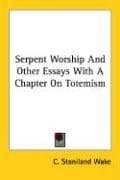
Serpent-Worship, and Other Essays, with a Chapter on TotemismWake, C. Staniland (Charles Staniland)
Religion
Serpent-Worship, and Other Essays, with a Chapter on Totemism
Wake, C. Staniland (Charles Staniland)
Phallicism; Serpent worship; Totemism
has been paid.”[242] Notwithstanding the example of the Todas, it must
not be thought that a scarcity of women is essential to the existence
of polyandry. In Tibet this system of marriage is universal, and it
has been so from time immemorial. Nevertheless, unmarried women are
numerous, and infanticide is not practised. Mr. Andrew Wilson defined
Tibetan polyandry as the marriage of one woman to two or more brothers,
and these are actual brothers, although at one time probably they may
also have been tribal. The choice of a wife is the right of the elder
brother, and Mr. Wilson states[243] that “among the Tibetan-speaking
people it universally prevails that the contract he makes is understood
to involve a marital contract with all the brothers, if they choose to
avail themselves of it.” Moreover, all the children of the marriage
belong to the eldest brother, as the head of the family group. In
Ladak,[244] however, the consent of the younger brothers is required
to the marital partnership, although on the death of the eldest brother
his authority, with his property and his widow, devolve upon his next
brother, whether or not there has been a polyandrous arrangement.
Mr. Wilson observes[245] that Tibetan polyandry had the effect “of
checking the increase of population in regions from which emigration
is difficult, and where it is also difficult to increase the means
of subsistence.” It is due to an artificial scarcity of _wives_,
rather than of women, in which it differs from the polyandry of the
Todas, which is the consequence of an actual scarcity of females,
caused originally by the practice of infanticide, and afterwards by a
preponderance of male births. Both the Tibetans and the Todas trace
descent through the male line—that is, take the family or gentile
name of the father; but some peoples of Southern India, who practice
polyandry, prefer the female line. This is not surprising, when we
find, as among the Nairs of Malabar, that not only has a woman several
husbands, but a man “may be one in several combinations of husbands.”
Such unions, which are governed by certain restrictions as to tribe and
caste, closely resemble the Australian group marriage. In Ceylon, where
polyandry is very prevalent among the Kandyans, marriage is of two
forms, one termed _deega_, in which the wife goes to live in the house
and village of her husband or husbands, the other, termed _beena_, in
which the husband or husbands come to reside with her in the house
of her birth. The Tibetan polyandry may be a form of the _deega_
marriage, and the Nair polyandry a form of the _beena_ marriage,
although it is possible that the latter may be a “mere freak,” if it
be true (as Mr. Wilson affirms) that the Nairs are nominally married
to girls of their own caste, but never have any intercourse with their
wives, who may have as many lovers as they please, provided they are
Brahmins or Nairs, other than the husband. These lovers answer to the
Public-domain text, read in full here on John Shaqi.
Reviews
Reviews
No reviews yet
Be the first to share your thoughts on this work.
Elsewhere in the archive
Join the Discussion
Join the discussion
Sign in to leave a comment or review.
Sign InorCreate an account