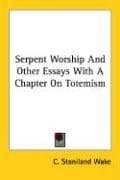
Serpent-Worship, and Other Essays, with a Chapter on TotemismWake, C. Staniland (Charles Staniland)
Religion
Serpent-Worship, and Other Essays, with a Chapter on Totemism
Wake, C. Staniland (Charles Staniland)
Phallicism; Serpent worship; Totemism
This system has attained its
chief development among the Semitic races and those African peoples who
are allied to them by blood. The most widely-spread forms of marriage
now existing are polygamy and monogamy, and while the former may be
traced to the polygamous phase of punalua or group marriage, it is not
improbable that the latter is traceable to the polyandrous phase. At
all events, monogamy has been established chiefly among those races
who are supposed, formerly, to have been polyandrous. The Australians,
among whom group marriage has reached so full a development, are said
to show a tendency to the introduction of individual marriage. Descent
through the female line, which was, at one time, universal among
them, is giving place to descent through males, where residence has
become fixed and property accumulated. The change is accompanied by a
weakening of the group right, and the gradual introduction of marriage
“by gifts, by exchange, by capture, and by elopement, one or other of
these predominating.” The rights of the individual are thus substituted
for those of the group, and individual marriage is recognised.
Strange as are the various marriage systems we have referred to, they
are based on the very simple principle that every individual has a
sexual right. The conditions under which this right may be exercised
vary among different peoples, their operation giving rise to the
peculiar married arrangements in question. Among the Australians,
almost the only restriction on sexual unions appears to be that arising
from consanguinity. Their marriage regulations have evidently been
formed with the intention of absolutely prohibiting unions between
persons near of kin. Although marriage with a sister of the half-blood
is often permitted, and for special reasons marriage with a full sister
may be allowed, the objection to consanguineous unions may be declared
to be universal among peoples of a low degree of culture. Their
marriage regulations, however, are generally intended to have certain
positive results. The chief result aimed at would seem to be the
prevention of over-population. This fact, combined with the recognition
of the sexual rights of man, accounts for the polyandry of the Tibetans
and the Hindus, and the attainment of it is in many cases aided by the
practice of infanticide. Polygamy, on the other hand, has no apparent
relation to the question of population. It is connected rather with the
rights of the gens or family to which the women belong, the man having,
in many cases, certain duties to perform before he can obtain his wife
or wives. The development of polygamy is, moreover, attended with an
invasion of the sexual rights of individuals; as the appropriation of
the women by the rich or powerful often renders the obtaining of wives
by the poor or weak difficult, if not impossible.
Public-domain text, read in full here on John Shaqi.
Reviews
Reviews
No reviews yet
Be the first to share your thoughts on this work.
Elsewhere in the archive
Join the Discussion
Join the discussion
Sign in to leave a comment or review.
Sign InorCreate an account