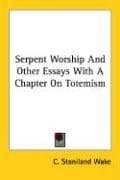
Serpent-Worship, and Other Essays, with a Chapter on TotemismWake, C. Staniland (Charles Staniland)
Religion
Serpent-Worship, and Other Essays, with a Chapter on Totemism
Wake, C. Staniland (Charles Staniland)
Phallicism; Serpent worship; Totemism
Nor is woman exactly without _rights_ among uncultured peoples.
At first these relate to the disposition of her own person before
marriage, and the existence of such a right is implied in the
widespread customs which have been thought to give evidence of the
primitive social phase described as “marriage by capture.” Mr.
Darwin, in his work, “The Descent of Man,” well points out that among
uncultured peoples girls have more choice in the matter of marriage
than is usually supposed.
It by no means follows that the position of a woman is, among
uncultured peoples, more bearable because she has managed to marry the
man whom she prefers. Where the marriage has been preceded by actual
attachment, no doubt it usually is so; and in that case, especially if
she has much intelligence, a wife may have great influence over her
husband. It is probable that polygamy has been an important instrument
in improving the condition of the married woman. With most uncultured
peoples who practise polygamy, a first wife is the head wife, and all
the succeeding ones are under her control. The former thus occupies a
position of influence in the household; she is less roughly treated by
her husband, and she gradually acquires certain rights. Mr. Shooter
says that, among the Kafirs, all the cows which a man possesses at
the time of his earliest marriage are regarded as the property of his
first wife, and after the birth of her first son they are called _his_
cattle. Theoretically, the husband can neither sell nor dispose of them
without his wife’s consent. Cattle are assigned to each of the wives
whom the husband subsequently takes, and the wife who furnishes the
cattle to purchase and endow a new wife, is entitled to her services,
and calls her “_my_ wife.” These rights of property are, however, in
reality of very slight value. On the death of the husband, the women
of his household descend to the son who is entitled to the cattle
belonging to each family division, and if he dies without direct heirs,
to the next male relative, who is nevertheless bound to provide for
them.
Public-domain text, read in full here on John Shaqi.
Reviews
Reviews
No reviews yet
Be the first to share your thoughts on this work.
Elsewhere in the archive
Join the Discussion
Join the discussion
Sign in to leave a comment or review.
Sign InorCreate an account