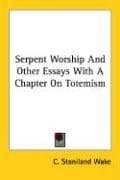
Serpent-Worship, and Other Essays, with a Chapter on TotemismWake, C. Staniland (Charles Staniland)
Religion
Serpent-Worship, and Other Essays, with a Chapter on Totemism
Wake, C. Staniland (Charles Staniland)
Phallicism; Serpent worship; Totemism
if we view man as the necessary product of the evolution of organic
nature. We may well believe that when the sudden advance from the ape
structure to that of man was made, under the conditions above proposed,
the great increase in the size of the brain and the change in the
position of the foramen magnum were accompanied by an alteration in the
order of development, not only of the different parts of the brain,
but also of the internal apparatus as pointed out by M. Pruner Bey.
But the advance having once taken place, the human type can no more be
lost; and although the approach to the simian type which appears in the
abnormal microcephalic brain evidences the intimate connection between
man and the ape, yet it furnishes no disproof of derivation, one from
the other, by the agency of internal evolutional impulse.
In conclusion, I would again refer to the fact, so strongly insisted
on by M. Broca, that the truth of the theory of evolution is not
dependent on that of the hypothesis of natural selection. The great
defect of “natural selection” as an agent in organic evolution, is that
it cannot do more than perpetuate certain structural peculiarities,
the appearance of which it is powerless to explain. The hypothesis is
properly defined as “natural selection among spontaneous variations;”
and it is the appearance of these variations which constitutes the
most important part of the problem. They can be explained only on the
assumption of “an internal tendency to deviate from the parental type;”
and granting that this tendency results from a necessary evolution
of nature viewed as an organic whole, there is no difficulty in
accounting for all the facts dwelt on by Mr. Darwin without supposing
the derivation of man from the ape by simple descent, although not
without identifying the universe with Deity, and viewing its various
manifestations as His organs.
FOOTNOTES:
[364] “The Descent of Man,” vol. i., p. 10, _et seq._
[365] “L’Ordre des Primates,” p. 173 (1870).
[366] _Ibid._, p. 168.
[367] _Ibid._, p. 173.
[368] _Op. cit._, vol. i., p. 48.
[369] _Ibid._, p. 63.
[370] _Ibid._, p. 70, _et seq._
[371] _Ibid._, p. 105.
[372] _Ibid._, p. 56.
[373] “Generelle Morphologie der Organismen,” vol. ii., p. 430 (1866).
[374] _Op. cit._, vol. i., p. 145.
[375] “Natural Selection,” p. 343 (1870).
[376] _Op. cit._, vol. i., p. 56.
[377] Darwin, _op. cit._, vol. i., p. 141.
[378] See Owen’s “Anatomy of the Vertebrates,” vol. iii., p. 186.
[379] _Op. cit._, vol. ii., p. 376.
[380] The “Academy,” No. 20, p. 183 (1871).
[381] “Revue des Cours Scientifiques,” 30th July, 1870, p. 558.
[382] “Descent of Man,” vol. i., p. 152.
[383] “First Principles,” 2nd edition, p. 447, n.
[384] “Principles of Biology,” vol. i., p. 430.
[385] “Lay Sermons,” p. 326.
[386] “Principles of Biology,” vol. i., p. 446.
[387] _Op. cit._, vol. iii., p. 808.
[388] “First Principles,” 2nd edition, p. 489.
[389] _Ibid._, p. 500.
Public-domain text, read in full here on John Shaqi.
Reviews
Reviews
No reviews yet
Be the first to share your thoughts on this work.
Elsewhere in the archive
Join the Discussion
Join the discussion
Sign in to leave a comment or review.
Sign InorCreate an account