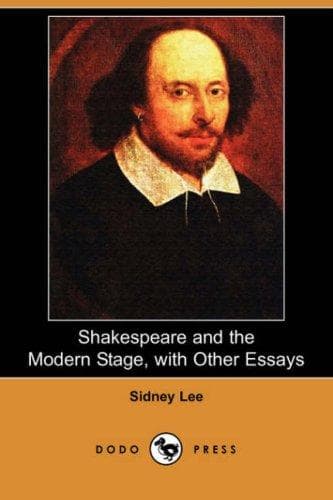
Shakespeare and the Modern Stage; with Other EssaysLee, Sidney, Sir
History
Shakespeare and the Modern Stage; with Other Essays
Lee, Sidney, Sir
Shakespeare, William, 1564-1616; Shakespeare, William, 1564-1616 -- Stage history
"Shakespeare," writes this French worshipper, "is a friend whom Heaven
has given to the unhappy of every age and every country." The writer
warns us that he offers no eulogy of Shakespeare; that is to be found
in the poet's works, which the Frenchman for his own part prefers to
read and read again rather than waste time in praising them. "The
features of Alexander ought only to be preserved by Apelles." Nodier
merely collects some of Shakespeare's thoughts on great moral truths
which he thinks to be useful to the conduct of life. But such
extracts, he admonishes his reader, supply no true knowledge of
Shakespeare. "From Shakespeare's works one can draw forth a
philosophy, but from no systems of philosophy could one construct one
page of Shakespeare." Nodier concludes his "Observations" thus:--
"I advise those who do not know Shakespeare to study him in
himself. I advise those who know him already to read him
again.... I know him, but I must needs declare my admiration
for him. I have reviewed my powers, and am content to cast a
flower on his grave since I am not able to raise a monument
to his memory."
Language like this admits no questioning of its sincerity. Nodier's
modest tribute handsomely atones for his countrymen's misapprehensions
of Shakespeare's tragic conceptions. None has phrased more delicately
or more simply the sense of personal devotion, which is roused by
close study of his work.
XI
THE COMMEMORATION OF SHAKESPEARE IN LONDON[44]
[Footnote 44: This paper was first printed in _The Nineteenth Century
and After_, April 1905.]
I
The public memory is short. At the instant the suggestion that
Shakespeare should receive the tribute of a great national monument in
London is attracting general attention. In the ears of the vast
majority of those who are taking part in the discussion the proposal
appears to strike a new note. Few seem aware that a national memorial
of Shakespeare has been urged on Londoners many times before. Thrice,
at least, during the past eighty-five years has it exercised the
public mind.
At the extreme end of the year 1820, the well-known actor Charles
Mathews set on foot a movement for the erection of "a national
monument to the immortal memory of Shakespeare." He pledged himself to
enlist the support of the new King, George the Fourth, of members of
the royal family, of "every man of rank and talent, every poet,
artist, and sculptor." Mathews's endeavour achieved only a specious
success. George the Fourth, readily gave his "high sanction" to a
London memorial. Sir Walter Scott, Samuel Taylor Coleridge, Tom Moore,
and Washington Irving were among the men of letters; Sir Thomas
Lawrence, [Sir] Francis Chantrey, and John Nash, the architect, were
among the artists, who approved the general conception. For three or
four years ink was spilt and breath was spent in the advocacy of the
scheme. But nothing came of all the letters and speeches.
Public-domain text, read in full here on John Shaqi.
Reviews
Reviews
No reviews yet
Be the first to share your thoughts on this work.
Elsewhere in the archive
Join the Discussion
Join the discussion
Sign in to leave a comment or review.
Sign InorCreate an account