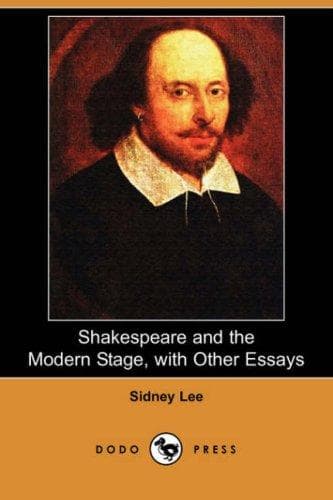
Shakespeare and the Modern Stage; with Other EssaysLee, Sidney, Sir
History
Shakespeare and the Modern Stage; with Other Essays
Lee, Sidney, Sir
Shakespeare, William, 1564-1616; Shakespeare, William, 1564-1616 -- Stage history
In order to satisfy the commemorative instinct in a people, it is
necessary, as Bacon pointed out, strictly to adapt the means to the
end. The essential object of a national monument to a great man is to
pay tribute to his greatness, to express his fellow-men's sense of his
service. No blunder could be graver than to confuse the issue by
seeking to make the commemoration serve any secondary or collateral
purpose. It may be very useful to erect hospitals or schools. It may
help in the dissemination of knowledge and appreciation of
Shakespearean drama for the public to endow a theatre, which should be
devoted to the performance of Shakespeare's plays. The public interest
calls loudly for a playhouse that shall be under public control.
Promoters of such a commendable endeavour might find their labours
facilitated by associating their project with Shakespeare's name--with
the proposed commemoration of Shakespeare. But the true aim of the
commemoration will be frustrated if it be linked with any purpose of
utility, however commendable, with anything beyond a symbolisation of
Shakespeare's mighty genius and influence. To attempt aught else is
"wrenching the true cause the false way." A worthy memorial to
Shakespeare will not satisfy the just working of the commemorative
instinct, unless it take the sculpturesque and monumental shape which
the great tradition of antiquity has sanctioned. A monument to
Shakespeare should be a monument and nothing besides.
Bacon's doctrine that the greater the achievement that is commemorated
the richer must be the outward symbol, implies that a memorial to
Shakespeare must be a work of art of the loftiest merit conceivable.
Unless those who promote the movement concentrate their energies on an
object of beauty, unless they free the movement of all suspicion that
the satisfaction of the commemorative instinct is to be a secondary
and not the primary aim, unless they resolve that the Shakespeare
memorial in London is to be a monument pure and simple, and one as
perfect as art can make it, then the effort is undeserving of national
support.
IX
This conclusion suggests the inevitable objection that sculpture in
England is not in a condition favourable to the execution of a great
piece of monumental art. Past experience in London does not make one
very sanguine that it is possible to realise in statuary a worthy
conception of a Shakespearean memorial. The various stages through
which recent efforts to promote sculptured memorials in London have
passed suggest the mock turtle's definition in _Alice in Wonderland_
of the four branches of arithmetic--Ambition, Distraction,
Uglification, and Derision. Save the old statue of James the Second,
at Whitehall, and the new statue of Oliver Cromwell, which stands at
a disadvantage on its present site beneath Westminster Hall, there is
scarcely a sculptured portrait in the public places of London which is
not
Public-domain text, read in full here on John Shaqi.
Reviews
Reviews
No reviews yet
Be the first to share your thoughts on this work.
Elsewhere in the archive
Join the Discussion
Join the discussion
Sign in to leave a comment or review.
Sign InorCreate an account