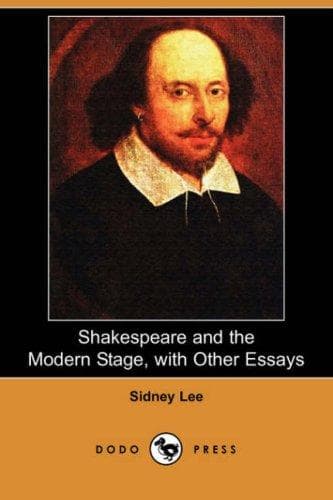
Shakespeare and the Modern Stage; with Other Essays — John Shaqi
Shakespeare and the Modern Stage; with Other EssaysLee, Sidney, Sir
History
Shakespeare and the Modern Stage; with Other Essays
Lee, Sidney, Sir
Shakespeare, William, 1564-1616; Shakespeare, William, 1564-1616 -- Stage history
One of the earliest of the elegies was a sonnet by William Basse, who
gave picturesque expression to the conviction that Shakespeare would
enjoy for all time an unique reverence on the part of his countrymen.
In the opening lines of his poem Basse apostrophised Chaucer, Spenser,
and the dramatist Francis Beaumont, three poets who had already
received the recognition of burial in Westminster Abbey--Beaumont, the
youngest of them, only five weeks before Shakespeare died. To this
honoured trio Basse made appeal to "lie a thought more nigh" one
another, so as to make room for the newly-dead Shakespeare within
their "sacred sepulchre." Then, in the second half of his sonnet, the
poet, developing a new thought, argued that Shakespeare, in right of
his pre-eminence, merited a burial-place apart from all his fellows.
With a glance at Shakespeare's distant grave in the chancel of
Stratford-on-Avon Church, the writer exclaimed:--
Under this carved marble of thine own
Sleep, brave tragedian, Shakespeare, sleep _alone_.
The fine sentiment found many a splendid echo. It resounded in Ben
Jonson's lines of 1623:--
My Shakespeare, rise! I will not lodge thee by
Chaucer, or Spenser, or bid Beaumont lie
A little further to make thee a room.
Thou art a monument without a tomb,
And art alive still, while thy book doth live
And we have wits to read and praise to give.
Milton wrote a few years later, in 1630, how Shakespeare, "sepulchred"
in "the monument" of his writings,
in such pomp doth lie,
That kings for such a tomb would wish to die.
Never was a glorious immortality foretold for any man with more solemn
confidence than it was foretold for Shakespeare at his death by his
circle of adorers. When Time, one elegist said, should dissolve his
"Stratford monument," the laurel about Shakespeare's brow would wear
its greenest hue. Shakespeare's critical friend, Ben Jonson, was but
one of a numerous band who imagined the "sweet swan of Avon," "the
star of poets," shining for ever as a constellation in the firmament.
Such was the invariable temper in which literary men gave vent to
their grief on learning the death of the "beloved author," "the famous
scenicke poet," "the admirable dramaticke poet," "that famous writer
and actor," "worthy master William Shakespeare" of Stratford-on-Avon.
II
Public-domain text, read in full here on John Shaqi.
Reviews
Reviews
No reviews yet
Be the first to share your thoughts on this work.
Join the Discussion
Join the discussion
Sign in to leave a comment or review.
Sign InorCreate an account