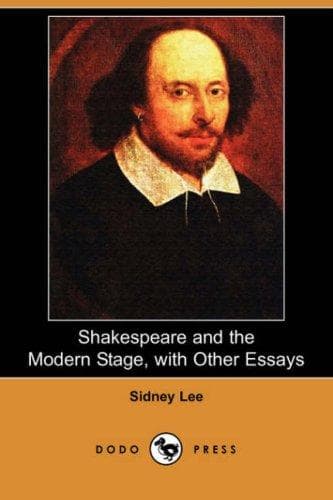
Shakespeare and the Modern Stage; with Other EssaysLee, Sidney, Sir
History
Shakespeare and the Modern Stage; with Other Essays
Lee, Sidney, Sir
Shakespeare, William, 1564-1616; Shakespeare, William, 1564-1616 -- Stage history
Unqualified and sincere was the eulogy awarded to Shakespeare, alike
in his lifetime and immediately after his death. But the spirit and
custom of the age confided to future generations the duty of first
offering him the more formal honour of prosaic and critical biography.
The biographic memoir, which consists of precise and duly
authenticated dates and records of domestic and professional
experiences and achievements, was in England a comparatively late
growth. It had no existence when Shakespeare died. It began to blossom
in the eighteenth century, and did not flourish luxuriantly till a far
more recent period. Meagre seeds of the modern art of biography were,
indeed, sown within a few years of Shakespeare's death; but outside
the unique little field of Izaak Walton's tillage, the first
sproutings were plants so different from the fully developed tree,
that they can with difficulty be identified with the genus. Apart from
Izaak Walton's exceptional efforts, the biographical spirit first
betrayed itself in England in slender, occasional pamphlets of
rhapsodical froth, after the model of the funeral sermon. There
quickly followed more substantial volumes of collective biography,
which mainly supplied arbitrarily compiled, if extended, catalogues of
names. To each name were attached brief annotations, which
occasionally offered a fact or a date, but commonly consisted of a few
sentences of grotesque, uncritical eulogy.
Fuller's _Worthies of England_, which was begun about 1643 and was
published posthumously in 1662, was the first English compendium of
biography of this aboriginal pattern. Shakespeare naturally found
place in Fuller's merry pages, for the author loved in his eccentric
fashion his country's literature, and he had sought the society of
those who had come to close quarters with literary heroes of the past
generation. Of that generation his own life just touched the fringe,
he being eight years old when Shakespeare died. Fuller described the
dramatist as a native of Stratford-on-Avon, who "was in some sort a
compound of three eminent poets"--Martial, "in the warlike sound of
his name"; Ovid, for the naturalness and wit of his poetry; and
Plautus, alike for the extent of his comic power and his lack of
scholarly training. He was, Fuller continued, an eminent instance of
the rule that a poet is born not made. "Though his genius," he warns
us, "generally was jocular and inclining him to festivity, yet he
could, when so disposed, be solemn and serious." His comedies, Fuller
adds, would rouse laughter even in the weeping philosopher Heraclitus,
while his tragedies would bring tears even to the eyes of the laughing
philosopher Democritus.
Of positive statements respecting Shakespeare's career Fuller is
economical. He commits himself to nothing more than may be gleaned
from the following sentences:--
Public-domain text, read in full here on John Shaqi.
Reviews
Reviews
No reviews yet
Be the first to share your thoughts on this work.
Join the Discussion
Join the discussion
Sign in to leave a comment or review.
Sign InorCreate an account