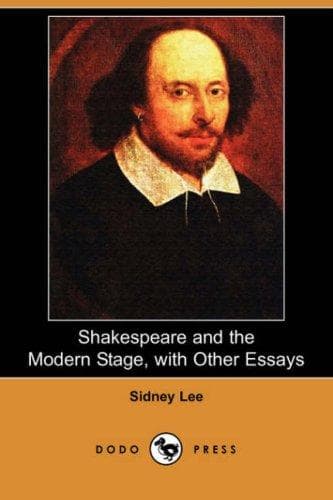
Shakespeare and the Modern Stage; with Other EssaysLee, Sidney, Sir
History
Shakespeare and the Modern Stage; with Other Essays
Lee, Sidney, Sir
Shakespeare, William, 1564-1616; Shakespeare, William, 1564-1616 -- Stage history
The more closely Shakespeare's career is studied the plainer it
becomes that his experiences and fortunes were identical with those of
all who followed in his day his profession of dramatist, and that his
conscious aims and ambitions and practices were those of every
contemporary man of letters. The difference between the results of his
endeavours and those of his fellows was due to the magical and
involuntary working of genius, which, since the birth of poetry, has
exercised "as large a charter as the wind, to blow on whom it
pleases." Speculation or debate as to why genius bestowed its fullest
inspiration on Shakespeare is no less futile than speculation or
debate as to why he was born into the world with a head on his
shoulders instead of a block of stone. It is enough for wise men to
know the obvious fact that genius endowed Shakespeare with its richest
gifts, and a very small acquaintance with the literary history of the
world and with the manner in which genius habitually plays its part
there, will show the folly of cherishing astonishment that
Shakespeare, rather than one more nobly born or more academically
trained, should have been chosen for the glorious dignity. Nowhere is
this lesson more convincingly taught than by a systematic survey of
the oral tradition. Shakespeare figures there as a supremely favoured
heir of genius, whose humility of birth and education merely serves to
intensify the respect due to his achievement.
In London, where Shakespeare's work was mainly done and his fortune
and reputation achieved, he lived with none in more intimate social
relations than with the leading members of his own prosperous company
of actors, which, under the patronage of the king, produced his
greatest plays. Like himself, most of his colleagues were men of
substance, sharers with him in the two most fashionable theatres of
the metropolis, occupiers of residences in both town and country,
owners of houses and lands, and bearers of coat-armour of that
questionable validity which commonly attaches to the heraldry of the
_nouveaux riches_. Two of these affluent associates predeceased
Shakespeare; and one of them, Augustine Phillips, attested his
friendship in a small legacy. Three of Shakespeare's fellow-actors
were affectionately remembered by him in his will, and a fourth, one
of the youngest members of the company, proved his regard for
Shakespeare's memory by taking, a generation after the dramatist's
death, Charles Hart, Shakespeare's grand-nephew, into his employ as a
"boy" or apprentice. Grand-nephew Charles went forth on a prosperous
career, in which at its height he was seriously likened to his
grand-uncle's most distinguished actor-ally, Richard Burbage. Above
all is it to be borne in mind that to the disinterested admiration for
his genius of two fellow-members of Shakespeare's company we owe the
preservation and publication of the greater part of his literary work.
Public-domain text, read in full here on John Shaqi.
Reviews
Reviews
No reviews yet
Be the first to share your thoughts on this work.
Elsewhere in the archive
Join the Discussion
Join the discussion
Sign in to leave a comment or review.
Sign InorCreate an account