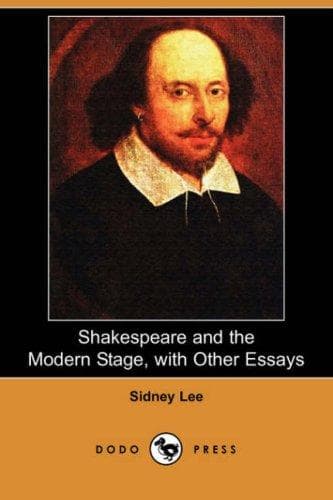
Shakespeare and the Modern Stage; with Other EssaysLee, Sidney, Sir
History
Shakespeare and the Modern Stage; with Other Essays
Lee, Sidney, Sir
Shakespeare, William, 1564-1616; Shakespeare, William, 1564-1616 -- Stage history
There is yet an additional scrap of oral tradition which, reduced to
writing about the time that Fuller was at work, confirms Shakespeare's
reputation for quickness of wit in everyday life, especially in
intercourse with the critical giant Jonson. Dr Donne, the Jacobean
poet and dean of St Paul's, told, apparently on Jonson's authority,
the story that Shakespeare, having consented to act as godfather to
one of Jonson's sons, solemnly promised to give the child a dozen good
"_Latin_ spoons" for the father to "translate." _Latin_ was a play
upon the word "latten," which was the name of a metal resembling
brass. The simple quip was a good-humoured hit at Jonson's pride in
his classical learning. Dr Donne related the anecdote to Sir Nicholas
L'Estrange, a country gentleman of literary tastes, who had no
interest in Shakespeare except from the literary point of view. He
entered it in his commonplace book within thirty years of
Shakespeare's death.
IV
Of the twenty-five actors who are enumerated in a preliminary page of
the great First Folio, as filling in Shakespeare's lifetime chief
roles in his plays, few survived him long. All of them came in
personal contact with him; several of them constantly appeared with
him on the stage from early days.
The two who were longest lived, John Lowin and Joseph Taylor, came at
length to bear a great weight of years. They were both Shakespeare's
juniors, Lowin by twelve years, and Taylor by twenty; but both
established their reputation before middle age. Lowin at twenty-seven
took part with Shakespeare in the first representation of Ben Jonson's
_Sejanus_ in 1603. He was an early, if not the first, interpreter of
the character of Falstaff. Taylor as understudy to the great actor
Burbage, a very close ally of Shakespeare, seems to have achieved some
success in the part of Hamlet, and to have been applauded in the role
of Iago, while the dramatist yet lived. When the dramatist died, Lowin
was forty, and Taylor over thirty.
Subsequently, as their senior colleagues one by one passed from the
world, these two actors assumed first rank in their company, and
before the ruin in which the Civil War involved all theatrical
enterprise, they were acknowledged to stand at the head of their
profession.[12] Taylor lived through the Commonwealth, and Lowin far
into the reign of Charles the Second, ultimately reaching his
ninety-third year. Their last days were passed in indigence, and Lowin
when an octogenarian was reduced to keeping the inn of the "Three
Pigeons," at Brentford.
Public-domain text, read in full here on John Shaqi.
Reviews
Reviews
No reviews yet
Be the first to share your thoughts on this work.
Elsewhere in the archive
Join the Discussion
Join the discussion
Sign in to leave a comment or review.
Sign InorCreate an account