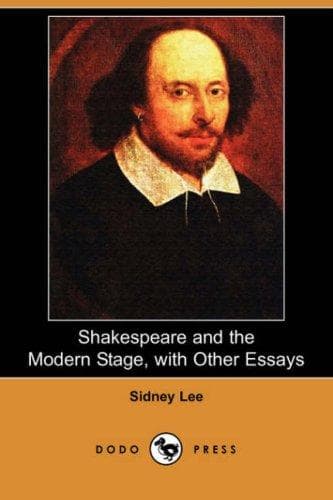
Shakespeare and the Modern Stage; with Other EssaysLee, Sidney, Sir
History
Shakespeare and the Modern Stage; with Other Essays
Lee, Sidney, Sir
Shakespeare, William, 1564-1616; Shakespeare, William, 1564-1616 -- Stage history
It was probably William Beeston's grandfather, also William Beeston,
to whom the satirical Elizabethan, Thomas Nash, dedicated in 1593,
with good-humoured irony, one of his insolent libels on Gabriel
Harvey, a scholar who had defamed the memory of a dead friend. Nash
laughed at his patron's struggles with syntax in his efforts to write
poetry, and at his indulgence in drink, which betrayed itself in his
red nose. But, in spite of Nash's characteristic frankness, he greeted
the first William Beeston as a boon companion who was generous in his
entertainment of threadbare scholars. Christopher Beeston, this man's
son, the father of the Shakespearean gossip, had in abundance the
hereditary taste for letters. He was at one time Shakespeare's
associate on the stage. Both took part together in the first
representation of Ben Jonson's _Every Man in His Humour_, in 1598. His
name was again linked with Shakespeare's in the will of their
fellow-actor, Augustine Phillips, who left each of them a legacy as a
token of friendship at his death in 1605. Christopher Beeston left
Shakespeare's company of actors for another theatre early in his
career, and his closest friend among the actor-authors of his day in
later life was not Shakespeare himself but Thomas Heywood, the popular
dramatist and pamphleteer, who lived on to 1650. This was a friendship
which kept Beeston's respect for Shakespeare at a fitting pitch.
Heywood, who wrote the affectionate lines:
Mellifluous Shakespeare, whose inchanting Quill
Commanded Mirth or Passion, was but _Will_,
enjoys the distinction of having published in Shakespeare's lifetime
the only expression of resentment that is known to have come from the
dramatist's proverbially "gentle lips." Shakespeare (Heywood wrote)
"was much offended" with an unprincipled publisher who "presumed to
make so bold with his name" as to put it to a book of which he was not
the author. And Beeston had direct concern with the volume called _An
Apology for Actors_, to which Heywood appended his report of these
words of Shakespeare. To the book the actor, Beeston, contributed
preliminary verses addressed to the author, his "good friend and
fellow, Thomas Heywood." There Beeston briefly vindicated the
recreation which the playhouse offered the public. Much else in
Christopher Beeston's professional career is known, but it is
sufficient to mention here that he died in 1637, while he was filling
the post that he had long held, of manager to the King and Queen's
Company of Players at the Cockpit Theatre in Drury Lane. It was the
chief playhouse of the time, and his wife was lessee of it.
Public-domain text, read in full here on John Shaqi.
Reviews
Reviews
No reviews yet
Be the first to share your thoughts on this work.
Elsewhere in the archive
Join the Discussion
Join the discussion
Sign in to leave a comment or review.
Sign InorCreate an account