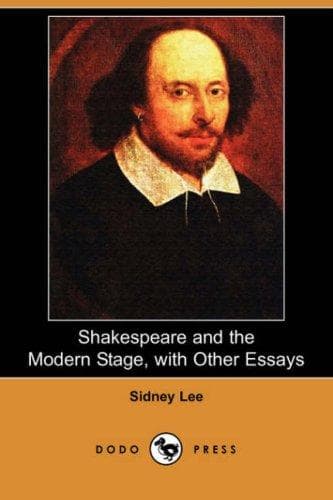
Shakespeare and the Modern Stage; with Other EssaysLee, Sidney, Sir
History
Shakespeare and the Modern Stage; with Other Essays
Lee, Sidney, Sir
Shakespeare, William, 1564-1616; Shakespeare, William, 1564-1616 -- Stage history
To learn the manner in which the child D'Avenant and his brothers came
to know Shakespeare is to approach the dramatist through oral tradition
at very close quarters. D'Avenant's father, a melancholy person who
was never known to laugh, long kept at Oxford the Crown Inn in Carfax.
Gossip which was current in Oxford throughout the seventeenth century,
and was put on record before the end of it by more than one scholar of
the university, establishes the fact that Shakespeare on his annual
journeys between London and Stratford-on-Avon was in the habit of
staying at the elder D'Avenant's Oxford hostelry. The report ran that
"he was exceedingly respected" in the house, and was freely admitted
to the inn-keeper's domestic circle. The inn-keeper's wife was
credited with a mercurial disposition which contrasted strangely with
her husband's sardonic temperament; it was often said in Oxford that
Shakespeare not merely found his chief attraction at the Crown Inn in
the wife's witty conversation, but formed a closer intimacy with her
than moralists would approve. Oral tradition speaks in clearer tones
of his delight in the children of the family--four boys and three
girls. We have at command statements on that subject from the lips of
two of the sons. The eldest son, Robert, who was afterwards a parson
in Wiltshire, and was on familiar terms with many men of culture,
often recalled with pride for their benefit that "Mr William
Shakespeare" had given him as a child "a hundred kisses" in his
father's tavern-parlour.
The third son, William, was more expansive in his reminiscences. It
was generally understood at Oxford in the early years of the
seventeenth century that he was the poet's godson, as his Christian
name would allow, but some gossips had it that the poet's paternity
was of a less spiritual character. According to a genuine anecdote of
contemporary origin, when the boy, William D'Avenant, in Shakespeare's
lifetime, informed a doctor of the university that he was on his way
to ask a blessing of his godfather who had just arrived in the town,
the child was warned by his interlocutor against taking the name of
God in vain. It is proof of the estimation in which D'Avenant held
Shakespeare that when he came to man's estate he was "content enough
to have" the insinuation "thought to be true." He would talk freely
with his friends over a glass of wine of Shakespeare's visits to his
father's house, and would say "that it seemed to him that he wrote
with Shakespeare's very spirit." Of his reverence for Shakespeare he
gave less questionable proof in a youthful elegy in which he
represented the flowers and trees on the banks of the Avon mourning
for Shakespeare's death and the river weeping itself away. He was
credited, too, with having adopted the new spelling of his name
D'_Aven_ant (for Davenant), so as to read into it a reference to the
river Avon.
Public-domain text, read in full here on John Shaqi.
Reviews
Reviews
No reviews yet
Be the first to share your thoughts on this work.
Elsewhere in the archive
Join the Discussion
Join the discussion
Sign in to leave a comment or review.
Sign InorCreate an account