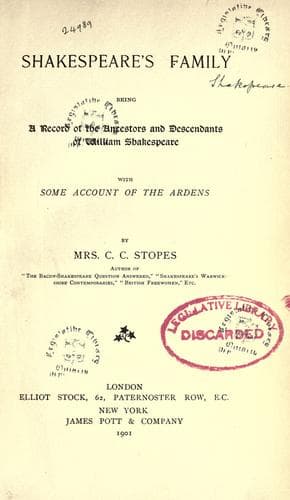
Shakespeare's familyStopes, C. C. (Charlotte Carmichael)
History
Shakespeare's family
Stopes, C. C. (Charlotte Carmichael)
Arden family; Shakespeare family; Shakespeare, William, 1564-1616 -- Family
Edward Arden was a temperate follower of the old faith; but his
son-in-law, John Somerville, an excitable youth, seemed to chafe under
the increasing oppression of the Catholic Church and its adherents.[417]
The evil reports concerning the Queen and Leicester increased the
friction. Shut out from travel or active exercise, as all Catholics then
were by law, he studied and pondered, and his mind seemed to have given
way in his sleepless attempts to reconcile faith and practice. He
started off suddenly one morning before anyone was awake, attended only
by one boy, who soon left him, terrified; and when he reached a little
inn on the lonely road by Aynho on the Hill, he spoke frantically to all
who chose to hear that he was going to London to kill the Queen.[418]
Then followed arrest, examination before Justice D'Oyley, a march to
London with twelve guards,[419] examination in the Gatehouse,
imprisonment in the Tower. Thereafter went forth the mandate to arrest
Edward Arden, his wife, Francis Arden, of Pedmore, his brother,
Somerville's wife and sister, and the priest, Hugh Hall. Sir John
Conway, his wife's grand-uncle, was also commanded up to London, and
seems to have been confined for a time. Examinations, probably under
torture, followed fast on each other. John Somerville, Edward Arden, his
wife and brother, and the priest, Hugh Hall, were tried, found guilty,
and condemned to the traitor's death. Hugh Hall is said to have turned
Queen's evidence, but I have found no proof of it. Somerville and Arden
were carried forth from the Tower on December 19, 1583, to Newgate, in
preparation for their execution on the morrow; Somerville was found two
hours afterwards strangled in his cell; Edward Arden suffered the full
penalty of the law December 20, 1583.[420] Robert of Leicester had his
revenge. Mrs. Arden and Francis[421] seem to have suffered a term of
imprisonment, and then to have been released.
This first noble victim of the tyrannical Royal Commission was praised
by all the writers of his time, and pitied by all Europe. Burleigh lived
to be ashamed of his part in his death; and in his "Life" one can still
read in the index "On the Case of Arden" an explanation which has been
excised from the text.
Public-domain text, read in full here on John Shaqi.
Reviews
Reviews
No reviews yet
Be the first to share your thoughts on this work.
Elsewhere in the archive
Join the Discussion
Join the discussion
Sign in to leave a comment or review.
Sign InorCreate an account