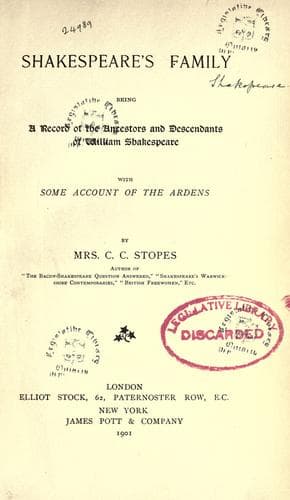
Shakespeare's familyStopes, C. C. (Charlotte Carmichael)
History
Shakespeare's family
Stopes, C. C. (Charlotte Carmichael)
Arden family; Shakespeare family; Shakespeare, William, 1564-1616 -- Family
Now, John Hall expressly calls himself a Master of Arts, though his name
is not recorded in the Books of the English Universities. He would not
have done so had he not taken his degree. It possibly might have been in
Paris, and he might have followed it up with foreign study. This would
quite accord with his appearance in Stratford after the death of
Elizabeth. A Warwickshire gentle origin[193] may somewhat account for
the degree of intimacy he seems to have had with the county families,
both Puritan and Catholic. His fame as a physician rapidly spread. He
resided in a house in Old Town, on the way from the church to the
chapel. His only daughter, Elizabeth, was baptized at Stratford on
February 21, 1607-8,[194] during her grandfather's (William
Shakespeare's) life. His name occurs in the town records in 1611,[195]
among the supporters to a Highway Bill, and he leased from the
Corporation a small stretch of wooded land on the outskirts of the town
in 1612. He must have remained on friendly terms with his father-in-law,
as he and his wife Susanna were left residuary legatees and executors of
Shakespeare's will, which he proved in June of that year, in the
Archbishop of Canterbury's Registry at London.
He shortly afterwards moved to New Place, beside his mother-in-law,
where the vestry notes of February 3, 1617-1618, record him as resident.
He was elected a Burgess of Stratford in 1617, and again in 1623, but
was excused from taking office on account of his professional
engagements. On April 22, 1626, Mr. Thomas Nash married his daughter,
Mrs. Elizabeth Hall. Hall gave the church a costly new pulpit, and in
1628 was appointed a borough churchwarden, in 1629 a sidesman, and in
1632 was compelled to become a burgess, and was soon after fined for
non-attendance at the council meetings.
In 1633 he was made the Vicar's churchwarden, and in that year the
Vicar, Thomas Wilson, induced him to join in a Chancery action against
the town. He was already in trouble with his fellow councillors, who in
October of that year expelled him for his "breach of orders, sundry
other misdemeanours, and for his continual disturbance at our Halles."
Evidently Dr. John had opinions of his own, and had the courage to
express them. He was a deeply religious man, and, though he has been
supposed to have shown Puritan tendencies in later life, it was a
Puritanism that did not eschew Catholicism. His was a religion of
constant reference to the Unseen. He was always a helper of those in
trouble for conscience' sake; and probably this was the reason he
supported the unpopular Vicar.
Public-domain text, read in full here on John Shaqi.
Reviews
Reviews
No reviews yet
Be the first to share your thoughts on this work.
Elsewhere in the archive
Join the Discussion
Join the discussion
Sign in to leave a comment or review.
Sign InorCreate an account