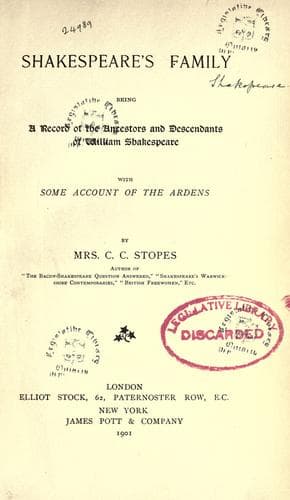
Shakespeare's familyStopes, C. C. (Charlotte Carmichael)
History
Shakespeare's family
Stopes, C. C. (Charlotte Carmichael)
Arden family; Shakespeare family; Shakespeare, William, 1564-1616 -- Family
Shortly after, in 1635, there was a petition sent up from the
Corporation of Stratford for their wives to have the pew in Stratford
Church occupied by Dr. Hall, his wife, and his son-in-law and his wife.
Each family had a pew at each side of the church, while there was not
room for the burgesses' wives to sit or kneel in. It was true that the
said Mr. Hall had been a great benefactor to the church, and the Bishop
of the diocese had appointed him his pew; but his family were asked to
choose which of their large pews they preferred to keep, along with Mrs.
Woodward and Mrs. Lane, so that they might allow the aldermen's wives to
have the other.
John Hall died on November 25, 1635, and was buried next day in the
chancel of the parish church, though he had already disposed of the
lease of the tithes purchased by his father-in-law.
The burial register of the next day describes him as "Medicus
Peritissimus." By a nuncupative will, he left a house in London to his
wife, a house in Acton and a meadow to his daughter Elizabeth, and his
study of books to his son-in-law Thomas Nash. The manuscripts he would
have given to Mr. Boles had he been present, but Nash was to keep them
and use them as he pleased. It is probable that Mr. Boles was Richard
Boles, Rector of Whitnash, not far from Stratford--an eccentric person,
a writer of epitaphs, who had set up his own in his church while he yet
lived.[196]
On the monumental slab of Dr. Hall is a shield of arms: "Sable, three
talbots' heads erased or" for Hall, impaling Shakespeare or on a bend
"sable, a spear of the first, the point steeled." "Here lyeth ye Body of
John Hall, gent: Hee marr: Susanna ye daughter and coheire of Will:
Shakespeare, gent., Hee deceased Nov^r 25, Anno 1635, aged 60.
"Hallius sic situs est, medica celeberrimus arte
Expectans regni Gaudia laeta Dei;
Dignus erat meritis qui nestora vinceret annis,
In terris omnes, sed capit aequa dies;
Ne tumulo quid desit adest fidessima conjux
Est vitae comitem nunc quoq. mortis habet."[197]
It has been thought that this proves the epitaph was not written until
after Mrs. Hall's death. She may have wished the words set up, to
determine her resting-place; or Mr. Boles may have helped Thomas Nash
with the Latin.
After his death his son-in-law, Thomas Nash, came to reside at New
Place, and took the position of head of the family. Indeed, in one of
his letters he speaks of "Mrs. Hall, my mother-in-law, who lives with
me." But the house and everything in it, saving the study of books,
belonged to Mrs. Hall, of course.
Public-domain text, read in full here on John Shaqi.
Reviews
Reviews
No reviews yet
Be the first to share your thoughts on this work.
Elsewhere in the archive
Join the Discussion
Join the discussion
Sign in to leave a comment or review.
Sign InorCreate an account