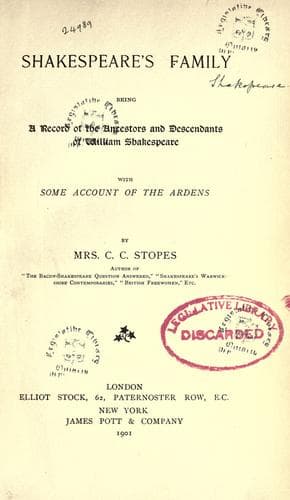
Shakespeare's familyStopes, C. C. (Charlotte Carmichael)
History
Shakespeare's family
Stopes, C. C. (Charlotte Carmichael)
Arden family; Shakespeare family; Shakespeare, William, 1564-1616 -- Family
In "Obs. XIX." Hall mentions without date an illness of his wife, Mrs.
Hall. "Obs. XXXVI." concerns his only daughter, and supports my opinion
of a constitutional delicacy of Anne Hathaway and her family. It is not
insignificant that her grandchild should suffer from "tortura oris," or
convulsions of the mouth, and ophthalmia. She was cured of one attack on
January 5, 1624. In the beginning of April she went to London, and on
returning on the 22nd of the same month, she took cold, and fell into
the same distemper, which affected the other side of her face. This
second time, "By the blessing of God, she was cured in sixteen days."
But on May 24 of the same year she was struck down with an erratic
fever. Sometimes she was hot, by-and-by sweating, again cold, all in the
space of half an hour. Her father's treatment again healed her; "the
symptoms remitted daily till she was well, thus was she delivered from
death and deadly diseases, and was well for many years." Many other
familiar names occur in this volume--"Mrs. Queeny," Mrs. Smith, Mr.
Wilson, Mrs. Throgmorton, Mrs. Sheldon, Mrs. Greene, John Nason, the
Underhills, Mrs. Baker, Dr. Thornbery, Bishop of Worcester (aged
eighty-six on February 1, 1633), Mrs. Combe, Katherine Sturley, "Mrs.
Grace Court, wife to my apothecary." In "Obs. LXIV." he speaks of
treating "the only son of Mr. Holyoake, which framed the dictionary."
"Obs. LXXXII.," Book II., records the restoration from the gates of
death of Mr. John Trapp, minister; and Obs. "LX.," Book II., gives an
account of Hall's own dangerous illness in 1632, when his anxious wife
sent for two physicians, who pulled him through; and he records his
prayer to God on the occasion. We must not forget that this was the date
of his quarrel with the Corporation.
The death of the young Quineys in 1638-39 affected the details of the
poet's will; for it may be remembered the property was settled on
Susanna Hall and her heirs male, failing whom, on the heirs male of
Elizabeth Hall, failing whom, on the heirs male of Judith, in default of
such heirs male, on the right heirs of William Shakespeare for ever. The
failure in the heirs male of Judith therefore entitled Elizabeth Nash to
the full inheritance as heir-general, and within a few weeks after the
unexpected death of her cousins, Susanna Hall, widow, joined with Mr.
and Mrs. Nash, May 27, 1639, in making a new settlement of Shakespeare's
entails on Mrs. Hall for life, after whom on Mr. and Mrs. Nash, and _the
longer liver of them_, after them, to the heirs of their body, and in
default of such, to the heirs of the said Elizabeth. Should she die
first without heirs, the property was secured to the _heirs and assignes
of the said Thomas Nash_, a reversion certainly not fair to Joan Hart,
the poet's sister, and her children. Still, it all seemed too far off to
consider. To this document Mrs. Hall appended her signature and her
seal, with the arms of Shakespeare impaled with those of Hall.
Public-domain text, read in full here on John Shaqi.
Reviews
Reviews
No reviews yet
Be the first to share your thoughts on this work.
Elsewhere in the archive
Join the Discussion
Join the discussion
Sign in to leave a comment or review.
Sign InorCreate an account