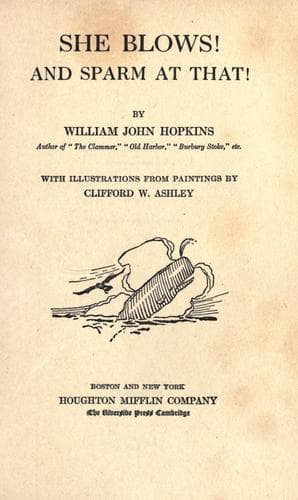
She Blows! And Sparm at That!Hopkins, William John
General
She Blows! And Sparm at That!
Hopkins, William John
Whaling
There was no unfavorable change in the weather, and we cruised
for three weeks without getting a whale, or even raising a spout.
One morning, however, after a rather thick haze had cleared away
somewhat, we found ourselves within half a mile of a pod of six or
seven, which were lying on the surface, spouting lazily. They did not
seem to be feeding, and I remember that I had heard a distant splash
while it was still too thick to see them, and Peter, to whom I had
turned inquiringly, had said that it was likely a whale breaching.
Almost everybody on board had heard it, and the lookouts were
doubled. They fully expected to sight whales, and they did sight them
from the masthead before we could see them from the deck. No cry was
given, but the men came down and reported.
There was hardly a breath of wind, and sound would carry easily in
that weather. Indeed, it was uncanny. There seemed to be streaks or
columns in the air which reflected the sound in the strangest ways,
or acted like a lens for sound, at one moment utterly cutting off
sounds that originated but a short distance away, and at the next
moment sending to us clearly faint noises made by the pod of whales
at a half-mile distance. Boats were lowered with the utmost care not
to make a noise, even being put into the water one end first, to
avoid any splash. The men were cautioned not to talk, and they sat
silent in their boats, cast off the falls quietly, and took to their
paddles as soon as the boats were in the water. It was of no use,
however. The whales were keeping tabs on us, and went down quietly
when a boat was within quarter of a mile of them, coming up half a
mile away. It was exasperating. There were whales almost at the side,
more than we had taken {174} in six months, and we could not get
near them; and after trying for hours, the boats were called back to
the ship.
I do not remember that I felt any disappointment, however. To tell
the truth, I was rather hoping for a pampero. It is not a fish, but
a wind. I had some vague recollection of the brief description in
Warren’s Physical Geography as a cold southwest wind which originates
in the Andes, and sweeps with great violence over the pampas of
Buenos Ayres, and is felt for some leagues at sea. My only comment
on this description is that I don’t believe it for a minute. We were
cruising just south of the latitude of Buenos Ayres, three or four
hundred miles from the coast. No wind whose origin is purely local,
in mountains even as high as the Andes, is at all likely to be of
the violence of the sample we had, after traversing the width of a
continent—narrow as it is at this latitude—and four hundred miles of
ocean. They must be fed from the pampas, be supplied with energy,
at least; and it seems much more reasonable to me to believe that
these winds originate over the pampas. They are of the nature of a
thunder-squall, and very probably of similar origin. But Warren can
hardly be considered a recent authority.
Public-domain text, read in full here on John Shaqi.
Reviews
Reviews
No reviews yet
Be the first to share your thoughts on this work.
Elsewhere in the archive
Join the Discussion
Join the discussion
Sign in to leave a comment or review.
Sign InorCreate an account