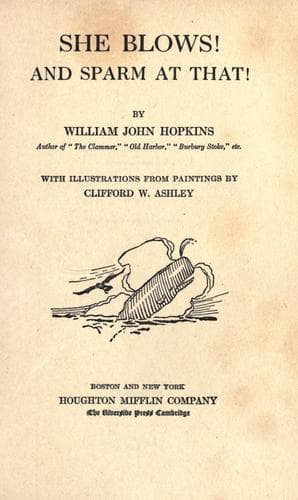
She Blows! And Sparm at That!Hopkins, William John
General
She Blows! And Sparm at That!
Hopkins, William John
Whaling
That was our last whale on these grounds, and we turned our nose
again to the southwest, for the grounds off Patagonia. Nourishing
the secret hope that we might land there, I carried the “Navigators”
around in my pocket, and read over again and again the account of
Magellan’s visit—all to no purpose, as it turned out. We saw nothing
of the Battles; but she had a nasty habit of turning up when we
thought we had lost her for good and least expected to see her. She
had become as a thorn in the flesh to Captain Nelson and Mr. Baker,
especially to Mr. Baker. I really think that at this time it would
have given him pleasure, as exquisite as he was capable of feeling,
actually to see her, with his own eyes, go down in deep water or
batter to pieces on a rocky shore. I know that he had reported to
Captain Nelson his controversy with her, his unsuccessful effort to
see Captain Coffin, and Wallet’s message. Captain Nelson was angry
for an instant, and his eyes darkened; then the whole thing seemed to
strike his sense of humor, which he had in plenty.
“Just as well,” he said, “you did n’t see Fred Coffin. I ’m going to
see Fred sooner or later—the first chance I get. And that settles
Wallet.”
We had good weather to the Patagonia grounds, mostly westerly and
northerly winds, and pretty strong, but nothing in the way of weather
could scare me now, after the Hatteras hurricane—of which we had
nothing more than a flirt from the skirt—and my taste of pampero. The
old ship made good time, as time goes for a whaler of her type, and
we arrived on the grounds to the north of the Falklands in about a
week. I was disappointed that we did not go even within sight of the
mainland of Patagonia. {190}
Albatrosses were a fairly common sight, however, and made up to me
somewhat for the lack of painted savages. In these latitudes there
was almost always at least one of these great birds in sight, and
although they were not always near the ship, they never failed to be
on hand when the cook emptied his pail of scraps over the side. I
never tired of watching their powerful, soaring flight. It seemed as
if they played with the ship, like porpoises. They would keep along
with us for a while, then suddenly shoot ahead or off to one side
until they were almost out of sight, without a motion of the wings,
so far as I could see. There must have been some slight motion of the
wings to adjust themselves to the wind or to the vertical angle at
which they were flying, but I could not detect it.
There have been various explanations, none of which is quite
satisfactory. One is that they make a long glide downward to get up
speed; and, having speed enough, they change their angle, and gain
height. How they can do this indefinitely without an occasional
flap, I never could see. Their slight rolling motion may do the
trick, first on one wing and then on the other. I do not pretend to
knowledge of the matter, but I am content to let a beautiful mystery
remain a mystery.
Public-domain text, read in full here on John Shaqi.
Reviews
Reviews
No reviews yet
Be the first to share your thoughts on this work.
Elsewhere in the archive
Join the Discussion
Join the discussion
Sign in to leave a comment or review.
Sign InorCreate an account