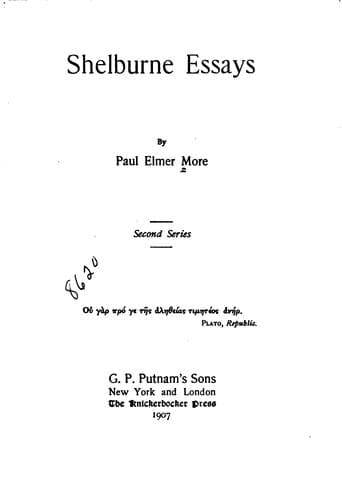
American literature -- History and criticism; English literature -- History and criticism
If he differed from the Broad Church mainly in his loyalty to Quaker
mysticism, it was Platonism which made the bounds of the High Church
too narrow for his faith. He did not hesitate at one time to say that
Plato possessed a truer spiritual insight than St. Paul, and it was in
reality a mere extension of the sphere of Platonism when, in what
appears to be the last letter he ever wrote (or dictated rather, for his
hands were already clasped in those of beneficent Death), he avowed his
creed: "That Image after which we were created--the Divine
Intellect--must surely be able to respond to the Divine call. The
greatest advance which has ever been made was the teaching, originally
by Aristotle, of the receptivity of matter.... I should be very glad to
see this idea of _John Inglesant_ worked out by an intelligent critic."
Beauty was for him a kind of transfiguration in which the world, in its
response to the indwelling Power, was lifted into something no longer
worldly, but divine; and he could speak of our existence on this earth
as lighted by "the immeasurable glory of the drama of God in which we
are actors." It was not that he, like certain poets of the past century,
attempted to give to the crude passions of men or the transient pomp of
earth a power intrinsically equivalent to the spirit; but he believed
that these might be made by faith to become as it were an illusory and
transparent veil through which the visionary eye could penetrate to the
mystic reality.
For the particular act in this drama, which he was to write out in his
religious novel, he went back to the seventeenth century, when, as it
seemed to him, the same problem as that of the nineteenth arose to
trouble the hearts of Englishmen, but in nobler and more romantic forms.
There was, in fact, a certain note of reality about the earlier struggle
of Puritan, Churchman, and Roman Catholic, which was lacking to the
quarrel of his own day. John Inglesant is the younger of twin sons born
in a family of Catholic sympathies. A Jesuit, Father Hall, who reminds
one not a little of Father Holt in _Henry Esmond_, is put in charge of
the boy and trains him up to be an intermediary between the Church of
England and the Church of Rome. To this end his Mentor keeps his mind in
a state of suspense between the faiths, and the inner and real drama of
the book is the contest in Inglesant's own mind, after his immediate
debt to Rome has been fulfilled, between the two forms of worship.
Public-domain text, read in full here on John Shaqi.
Reviews
Reviews
No reviews yet
Be the first to share your thoughts on this work.
Elsewhere in the archive
Join the Discussion
Join the discussion
Sign in to leave a comment or review.
Sign InorCreate an account