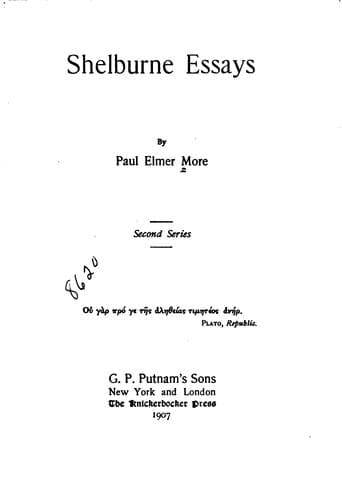
American literature -- History and criticism; English literature -- History and criticism
It was in this sense that Mr. Shorthouse could speak of his book as
above all an attempt "to promote culture at the expense of fanaticism,
including the fanaticism of work": but we shall miss the full meaning
of his intention if we omit the corollary of those words, viz.: "to
exalt the unpopular doctrine that the end of existence is not the good
of one's neighbour, but one's own culture." I do not know, indeed, but
this exaltation of the old theory that the chief purpose of religion is
the worship and beatitude of the individual soul, in opposition to the
humanitarian notions which were even then springing into prominence, is
the central theme of the story. Certainly with many readers the scene
that remains most deeply impressed in their memory is that which shows
Inglesant coming to Serenus de Cressy at the House of the Benedictines
in Paris, and, like the young man who came to Jesus, asking what he
shall do to make clear the guidance of the Inner Light. There, in those
marvellous pages, Cressy points out the divergence of the ways before
him: "On the one hand, you have the delights of reason and of intellect,
the beauty of that wonderful creation which God made, yet did not keep;
the charms of Divine philosophy, and the enticements of the poet's art;
on the other side, Jesus." And then as the old man, who had himself
turned from the gardens of Oxford to the discipline of a monastery, sees
the hesitation of his listener, he breaks forth into this eloquent
appeal:
I put before you your life, with no false colouring, no tampering
with the truth. Come with me to Douay; you shall enter our house
according to the strictest rule; you shall engage in no study
that is any delight or effort to the intellect; but you shall
teach the smallest children in the schools, and visit the poorest
people, and perform the duties of the household--and all for
Christ. I promise you on the faith of a gentleman and a priest--I
promise you, for I have no shade of doubt--that in this path you
shall find the satisfaction of the heavenly walk; you shall walk
with Jesus day by day, growing ever more and more like to Him; and
your path, without the least fall or deviation, shall lead more
and more into the light, until you come unto the perfect day; and
on your death-bed--the death-bed of a saint--the vision of the
smile of God shall sustain you, and Jesus Himself shall meet you
at the gates of eternal life.
Public-domain text, read in full here on John Shaqi.
Reviews
Reviews
No reviews yet
Be the first to share your thoughts on this work.
Elsewhere in the archive
Join the Discussion
Join the discussion
Sign in to leave a comment or review.
Sign InorCreate an account