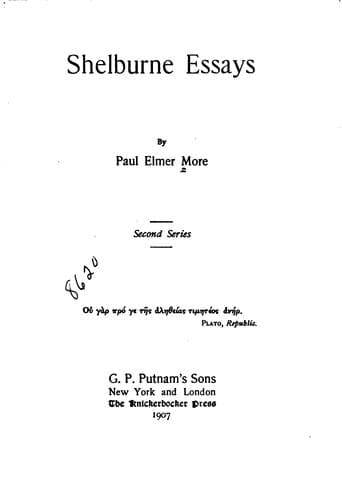
American literature -- History and criticism; English literature -- History and criticism
In the end Inglesant returns to England, after years spent in France and
Italy among Roman Catholics, and accepts frankly the religious forms of
his own land. His character had been strengthened by experience, and in
following the higher instincts of his own nature he had attained the
assurance and the sanctity of one who has not quailed before a great
sacrifice. The last scene in the book, the letter which relates the
conversation with Inglesant in the Cathedral Church at Worcester, should
be read as a complement to the earlier chapters which describe his
boyish search for what he was not to find save through the lesson of
years; the whole book may be regarded as a link between these two
presentations of the hero's life. It would require too many words to
repeat Inglesant's confession even in outline. "The Church of England,"
says the writer of the letter, "is no doubt a compromise, and is
powerless to exert its discipline.... If there be absolute truth
revealed, there must be an inspired exponent of it, else from age to age
it could not get itself revealed to mankind." And Inglesant replies:
"This is the Papist argument, there is only one answer to it--Absolute
truth is not revealed. There were certain dangers which Christianity
could not, as it would seem, escape. As it brought down the sublimest
teaching of Platonism to the humblest understanding, so it was
compelled, by this very action, to reduce spiritual and abstract truth
to hard and inadequate dogma. As it inculcated a sublime indifference to
the things of this life, and a steadfast gaze upon the future, so, by
this very means, it encouraged the growth of a wild unreasoning
superstition."
It is scarcely an exaggeration to say that those words, taken with the
plea which follows, express the finest wisdom struck out of the long and
for the most part futile Battle of the Churches; they were the creed of
Mr. Shorthouse, as they were the experience of the hero of his book. I
would end with that image of life as a sacred game with which Inglesant
himself closed his confession of faith at the Cathedral door:
The ways are dark and foul, and the grey years bring a mysterious
future which we cannot see. We are like children, or men in a
tennis court, and before our conquest is half won the dim twilight
comes and stops the game; nevertheless, let us keep our places,
and above all things hold fast by the law of life we feel within.
This was the method which Christ followed, and He won the world by
placing Himself in harmony with that law of gradual development
which the Divine Wisdom has planned. Let us follow in His steps
and we shall attain to the ideal life; and, without waiting for
our "mortal passage," tread the free and spacious streets of that
Jerusalem which is above.
THE QUEST OF A CENTURY
Public-domain text, read in full here on John Shaqi.
Reviews
Reviews
No reviews yet
Be the first to share your thoughts on this work.
Elsewhere in the archive
Join the Discussion
Join the discussion
Sign in to leave a comment or review.
Sign InorCreate an account