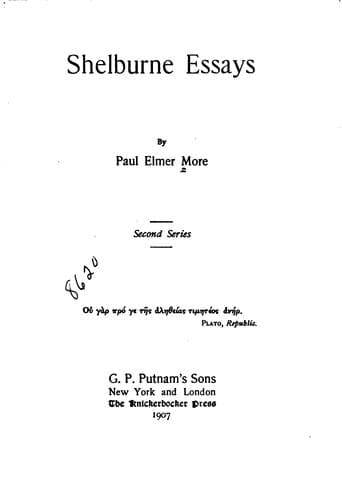
American literature -- History and criticism; English literature -- History and criticism
[10] Yet even while I read the proof of this page there lies before me
an article in the _Contemporary Review_ (July, 1905), in which Sir
Oliver Lodge utters the old assumptions of science with childlike
simplicity. "I want to urge," he says, "that my advocacy of science and
scientific training is not really due to any wish to be able to travel
faster or shout further round the earth, or to construct more extensive
towns, or to consume more atmosphere and absorb more rivers, nor even to
overcome disease, prolong human life, grow more corn, and cultivate to
better advantage the kindly surface of the earth; though all these
latter things will be 'added unto us' if we persevere in high aims. But
it is none of these things which should be held out as the ultimate
object and aim of humanity--the gain derivable from a genuine pursuit of
truth of every kind; no, the ultimate aim can be expressed in many ways,
but I claim that it is no less than to be able to comprehend what is the
length and breadth and depth and height of this mighty universe,
including man as part of it, and to know not man and nature alone, but
to attain also some incipient comprehension of what the saints speak of
as the love of God which passeth knowledge, and so to begin an entrance
into the fulness of an existence beside which the joy even of a perfect
earthly life is but as the happiness of a summer's day." The sentiment
is beautiful, but what shall we say of the logic? To speak of attaining
through _science_ a comprehension, even an incipient comprehension, of
that which passeth _knowledge_, is to fall into that curious confusion
of ideas to which the scientifically trained mind is subject when it
goes beyond its own field. "Gird up now thy loins like a man; for I will
demand of thee, and answer thou me. Where wast thou when I laid the
foundations of the earth? Declare, if thou hast understanding." Has Sir
Oliver read the Book of Job?
THE END.
* * * * *
Shelburne Essays
By Paul Elmer More
3 vols. Crown octavo.
Sold separately. Net, $1.25. (By mail, $1.35)
_Contents_
FIRST SERIES: A Hermit's Notes on Thoreau--The Solitude of
Nathaniel Hawthorne--The Origins of Hawthorne and Poe--The
Influence of Emerson--The Spirit of Carlyle--The Science of English
Verse--Arthur Symonds: The Two Illusions--The Epic of Ireland--Two
Poets of the Irish Movement--Tolstoy; or, The Ancient Feud between
Philosophy and Art--The Religious Ground of Humanitarianism.
SECOND SERIES: Elizabethan Sonnets--Shakespeare's Sonnets--Lafcadio
Hearn--The First Complete Edition of Hazlitt--Charles Lamb--Kipling
and FitzGerald--George Crabbe--The Novels of George
Meredith--Hawthorne: Looking before and after--Delphi and Greek
Literature--Nemesis; or, The Divine Envy.
Public-domain text, read in full here on John Shaqi.
Reviews
Reviews
No reviews yet
Be the first to share your thoughts on this work.
Elsewhere in the archive
Join the Discussion
Join the discussion
Sign in to leave a comment or review.
Sign InorCreate an account