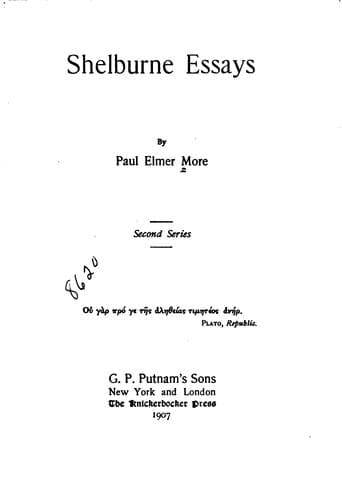
American literature -- History and criticism; English literature -- History and criticism
It would be exaggeration to say that all Browning's greater poems
proceed in this involved manner, yet the method is so constant as to be
the most significant feature of his work. And it bestows on him the
honour of having created a new genre which follows neither the fashion
of lyric on the one hand nor that of drama or narrative on the other,
but is a curious and illusive hybrid of the two. The passions are not
uttered directly as having validity and meaning in the heart of the
speaker alone, nor are they revealed through action and reaction upon
the emotions of another. His dramas, if read attentively, will be found
really to fall into the same mixed genre as his monologues. And a
comparison of his _Sordello_ with such a poem as Goethe's _Tasso_ (which
is more the dialogue of a narrative poem than a true drama) will show
how far he fails to make a character move visibly amid opposing
circumstances. In both poems we have a contrast of the poetical
temperament with the practical world. In Browning it is difficult to
distinguish the poet's own thought from the words of the hero; the
narrative is in reality a long confession of Sordello to himself who is
conscious of a hostile power without. In Goethe this hostile power
stands out as distinctly as Tasso himself, and they act side by side
each to his own end.
There is even a certain significance in what is perhaps the most
immediately personal poem Browning ever wrote, that _One Word More_
which he appended to his _Men and Women_. Did he himself quite
understand this lament for Raphael's lost sonnets and Dante's
interrupted angel, this desire to find his love a language,
Fit and fair and simple and sufficient--
Using nature that's an art to others,
Not, this one time, art that's turned his nature?
It would seem rather the uneasiness of his own mind when brought face to
face with strong feeling where no escape remains into his oblique mode
of expression. And the man Browning of real life, with his training in a
dissenting Camberwell home and later his somewhat dapper acceptance of
the London social season, accords with such a view of the writer. It is,
too, worthy of note that almost invariably he impressed those who first
met him as being a successful merchant, a banker, a diplomat--anything
but a poet. There was passion enough below the surface, as his outburst
of rage against FitzGerald and other incidents of the kind declare; but
the direct exhibition of it was painful if not grotesque.
Public-domain text, read in full here on John Shaqi.
Reviews
Reviews
No reviews yet
Be the first to share your thoughts on this work.
Elsewhere in the archive
Join the Discussion
Join the discussion
Sign in to leave a comment or review.
Sign InorCreate an account