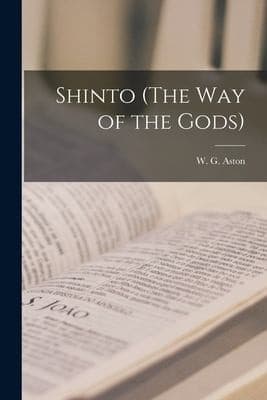
Shinto (the Way of the Gods)Aston, W. G. (William George)
Religion
Shinto (the Way of the Gods)
Aston, W. G. (William George)
Shinto
In 434 Prince Karu, then Heir to the Throne, fell in love with his
younger sister by the same mother. At first he dreaded the guilt
and was silent. But after a time he yielded to his passion. The
next year, in the height of summer, the soup for the Mikado's meal
froze and became ice. The diviner said, "There is domestic disorder
(incest)." This led to the discovery of Prince Karu's crime, but, as
he was successor to the Throne, he was not punished, and his sister
only was sent into banishment. After his father's death, however, the
ministers and people refused him their allegiance, and he ultimately
committed suicide, or, according to another version of the story,
went into exile. It is difficult to say whether the religious or the
merely moral element predominates in such a case. The portent by which
the Prince's crime was followed and the application to the diviners
indicate that the crime was thought offensive to the Gods. On the
other hand, banishment is a civil form of punishment, and the idea
that the offence might bring disaster on the community was probably at
the root of the indignation which it caused. Nor is it to be forgotten
that there is another non-religious reason for the law against incest.
Consanguineous unions are notoriously unfavourable to the propagation
of a numerous and healthy progeny, and therefore to the welfare of
the community. The 'Chüen,' a Chinese work written several centuries
before the Christian era, says: "When the man and woman are of the same
surname, the race does not continue." But in China too, the religious
sanction of the prohibition of incest is not absent. It is one of
those primarily non-religious sexual taboos, having for their object
to place a check on masculine tyranny over the weaker sex and the
premature, promiscuous, and excessive indulgence of the sexual passion
which even savages find to be fatal to the welfare of the individual
and the community, and whose transcendent importance and the difficulty
of enforcing them by law lead to be reinforced everywhere by religious
terrors. The prohibition of unions between brothers and sisters by
the mother's side--that is, practically of the full blood--and not of
those of the half-blood by the father's side, may be partly due to the
circumstance that the former are more commonly brought up together, and
a check on immature and consanguineous intercourse was more necessary
in their case. This taboo very likely dates from a period when
parentage was reckoned chiefly by maternity.
Vulgar licentiousness is not mentioned in the more ancient books as
causing ceremonial impurity.
Interference with the virgin priestesses was not only a source of
uncleanness, but was in some cases severely punished. The _Nihongi_
states that in A.D. 465
Public-domain text, read in full here on John Shaqi.
Reviews
Reviews
No reviews yet
Be the first to share your thoughts on this work.
Elsewhere in the archive
Join the Discussion
Join the discussion
Sign in to leave a comment or review.
Sign InorCreate an account