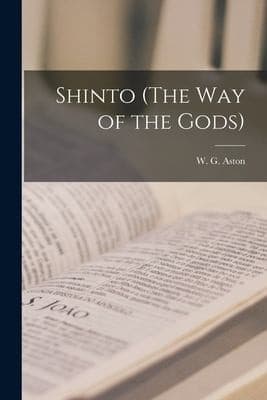
Shinto (the Way of the Gods)Aston, W. G. (William George)
Religion
Shinto (the Way of the Gods)
Aston, W. G. (William George)
Shinto
=Official Shinto=.--The official cult of the present day is
substantially the "Pure Shinto" of Motoöri and Hirata. But it has
little vitality. A rudimentary religion of this kind is quite
inadequate for the spiritual sustenance of a nation which in these
latter days has raised itself to so high a pitch of enlightenment and
civilization. No doubt some religious enthusiasm is excited by the
great festivals of Ise, Idzumo, and a few other shrines, and by the
annual pilgrimages--which, however, have other _raisons d'être_. The
reverence paid to the Mikado is not devoid of a religious quality which
has its source in Shinto. But the main stream of Japanese piety has cut
out for itself new channels. It has turned to Buddhism, which, at the
time of the Restoration in a languishing state, is now showing signs of
renewed life and activity. Another and still more formidable rival has
appeared, to whose progress, daily increasing in momentum, what limit
shall be prescribed?
As a national religion, Shinto is almost extinct. But it will long
continue to survive in folk-lore and custom, and in that lively
sensibility to the divine in its simpler and more material aspects
which characterizes the people of Japan.
THE END.
FOOTNOTES:
[331] For an account of Japanese Buddhism, consult Murray's 'Japan,' or
the more comprehensive description in Griffis's 'Religions of Japan.'
[332] See above, p. 175.
[333] The novelist Bakin, who cannot be charged with priestcraft, says:
"Shinto reverences the way of the Sun; the Chinese philosophers honour
Heaven; the teaching of Shaka fails not to make the Sun a deity. Among
differences of doctrine the fundamental principle is the same."
[334] In the old Shinto, Ne no kuni, or Hades, is not a place of
punishment for the wicked. Here it stands for the Jigoku, or Hell, of
the Buddhists.
[335] That is, Nature--a Chinese idea.
[336] This is Chinese.
[337] A Buddhist designation.
[338] And therefore unclean.
[339] See above, p. 179.
[340] As Sugahara himself was.
[341] See above, p. 155.
[342] See above, p. 177.
[343] Alluding to the inner and outer shrines of Ise.
[344] For a full account of the Revival of Pure Shinto, see Sir E.
Satow's papers contributed to the _T. A. S. J._ in 1875. Our knowledge
of Shinto dates from this time.
[345] An interesting account of this sect is given in a paper by Dr.
Greene in the _T. A. S. J._, December, 1895.
[346] See papers by Dr. Greene and Rev. A. Lloyd in the _T. A. S. J._,
1901.
INDEX.
_N.B.--Where there are several references the most important is placed
first._
A
Public-domain text, read in full here on John Shaqi.
Reviews
Reviews
No reviews yet
Be the first to share your thoughts on this work.
Elsewhere in the archive
Join the Discussion
Join the discussion
Sign in to leave a comment or review.
Sign InorCreate an account