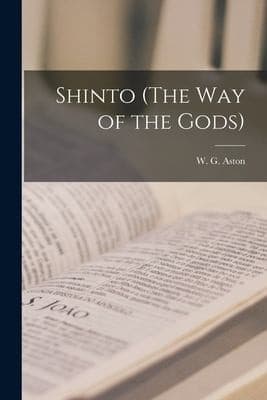
Shinto (the Way of the Gods)Aston, W. G. (William George)
Religion
Shinto (the Way of the Gods)
Aston, W. G. (William George)
Shinto
Mere inferences are often taken for facts, but, under normal
conditions, the imaginative man is not the dupe of his own inventive
faculty. It may be said that, however true this may be of more modern
religious myth, the attitude of the "primitive man" towards the naive
creations of his fancy is different. Strictly speaking, there is no
such thing as a primitive man. However far we may go back, we shall
find men with parents, and preceded by an infinite line of ancestors.
Still there can be no harm in using this term to designate mankind
at some ill-defined stage of progress above the highest lower animal
and below the savage of our own days. Strange things are told us of
the primitive man. He is said to be unable to distinguish between his
imaginations and facts, and that he is in the habit of taking his
dreams[49] for real occurrences. Fiske says: "Our primitive ancestors
knew nothing about laws of nature, nothing about physical forces,
nothing about the relations of cause and effect, nothing about the
necessary regularity of things.... The only force they knew was the
force of which they were directly conscious--the force of will.
Accordingly, they imagined all the outward world to be endowed with
volition and to be directed by it." Of course our primitive ancestors
expressed themselves differently from ourselves. They did not talk
about laws of nature and the necessary regularity of things. But can
we conceive them ignorant of the law of the regular alternation of
night and day, of summer and winter, of the phases of the moon? Did
not the "primitive man" know just as well as Newton that when an
apple is detached from a tree it falls to the ground? He knew that
from a blow as cause we may expect pain, wounds, or even death as the
effect. He had sufficient acquaintance with dynamics to be aware that
he could not raise himself from the ground more than a few feet, and
with chemistry to have learnt that the savour of food is improved or
spoilt, according to circumstances, by the application of fire. Nor
is it true that he ascribed all forces to volition. It is only by
exception that the child, the savage, and the primitive man attribute
life to inanimate things. This requires imagination, a faculty which is
notoriously feebler with them than with the adult civilized man. The
progress of humanity is from a sporadic towards a general recognition
of will in or behind the material universe, from fitful and sportive
fancies involving this idea to an earnest and steady conviction of
its truth, and from the fragmentary personification of the part as
animated to the conception of a living, universal whole. Agnosticism,
which ignores volition in matter, belongs, therefore, to the lower end
of the scale of progress. Where it appears in civilized man, it is a
case of arrested development. The average savage is a materialist, who
associates volition with the energies of nature in a much less thorough
Public-domain text, read in full here on John Shaqi.
Reviews
Reviews
No reviews yet
Be the first to share your thoughts on this work.
Elsewhere in the archive
Join the Discussion
Join the discussion
Sign in to leave a comment or review.
Sign InorCreate an account