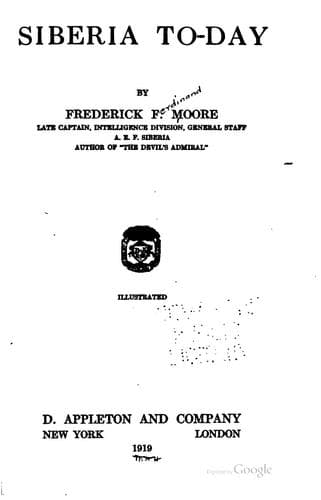
Siberia (Russia); Siberia (Russia) -- Description and travel
All I could do was to state that President Wilson was the head of my
government, and commander in chief of our army, and that no matter what
course he pursued, no matter what orders he or his subordinate officers
issued, I should obey. And that if I were in a position to know his
intentions and all the facts in the matter, my personal opinion could
have no effect upon my obedience to orders. And that I could not enter
into a discussion of decisions made in Paris or elsewhere regarding the
policy of the United States. Also, that I had faith that the United
States would act consistently with its history and aspirations, and for
the good of Russia. I asserted that the invitation to Prinkipo might
be a desire to get the Bolshevist leaders to define their position
regarding Russia, and to commit themselves to a line of action--in
other words to state their ideas and ideals. And if their desires did
not meet approval, then we would take a stand against Bolshevism and
the Bolshevists. But my arguments did not reassure him much--he felt
that all the damage had been done.
Now I found a new spirit among those persons who were known to me as
Bolshevist sympathizers. I had had many frank talks with some of these
people, and had listened to their arguments in favor of Bolshevism.
These people now became almost insolent. They told me in effect that
I ought to go home, as my president had taken preliminary steps to
recognize the Bolshevist government, seeing that it would be useless
to combat the Bolshevist rule. They were right, and I was wrong by
being there in their country, and what was I doing, they asked, walking
around with a pistol in my belt. My answer to this was, if my president
felt they were right, and that the presence of American troops in
Siberia was wrong, my president as commander in chief would withdraw
the American forces from Siberia. All my Bolshevist friends had to do,
and all I had to do, I told them, was wait for that order.
For an officer who was practically on diplomatic duty, it was rather a
peculiar position--far inland in Siberia, with all parties suspicious
of him and his government. The Bolshevists regarded me with more open
hostility, the anti-Bolshevists not quite sure I was a friend, the
principal Allied power in Chita somewhat hurt and suspicious that
it might be discredited in Siberia, and such Russians as concealed
whatever partisanship they secretly held, discouraged and believing
that their country was to be betrayed to the Bolshevists by the nation
which they looked to for the most aid and moral support. And American
officers and civilians were scattered through the country, practically
alone, and far from supporting or protecting troops.
Public-domain text, read in full here on John Shaqi.
Reviews
Reviews
No reviews yet
Be the first to share your thoughts on this work.
Elsewhere in the archive
Join the Discussion
Join the discussion
Sign in to leave a comment or review.
Sign InorCreate an account