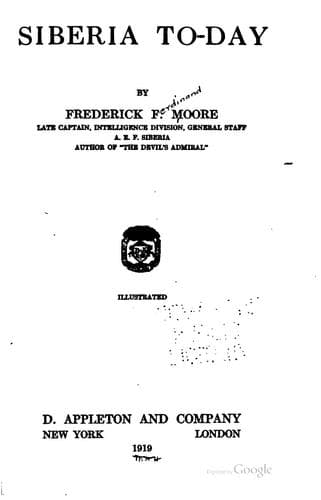
Siberia (Russia); Siberia (Russia) -- Description and travel
The whole question when our expedition first landed, was “What will
the United States do?” The answer in a couple of months was: “The
United States will do nothing--let us start something ourselves, which
will repay us for the trouble we have had fighting the Bolshevists.”
So the secret trading began, the forcing of loans from banks got
bolder, there was aid which we deprecated from certain quarters
to these Cossack chiefs. We played a dog-in-the-manger game, with
Christmas-Tree decorations in the form of Red Cross aid, and Y. M. C.
A., and Committee on Public Information, and Trade Boards. We conferred
and commissioned and sent official representatives in military uniform
to various places to make friends, while Bolshevists killed off a
vast population, and Cossack chiefs, under the plea of exterminating
Bolshevists, executed personal enemies.
We sent two or three hundred railroad engineers into the country, they
all thinking that they would be in the army. When they applied for
government insurance, they were told they were not in the army. But
they wore the uniforms and insignia of our army officers, and when some
of them wanted to get out of the country and go home, they were not
allowed to quit their jobs. Members of this organization told me that
they had been given to understand that if they insisted upon resigning,
they could do so, but that they need never again expect to hold a job
with an American railroad. And the Russians said that Russian money was
paying the salaries of these men--and that these Americans were there
to steal the railroad from the Russians. That may sound absurd. But
such absurdities thrust at men in Siberia are not pleasant. They reveal
to some slight extent the difficult environments in which Americans
found themselves in Siberia.
So while in January the temperature hung around seventy degrees below
zero, the social atmosphere was about as cold. Some weeks before,
having replied to a request that I class myself for discharge or for
permanent commission in the army, I had requested discharge.
On January twenty-sixth, in reply to my classification request, I
got orders to return to Vladivostok as soon as an officer who was to
relieve me, arrived in Chita. I had offered my services for the war,
and the war was over.
I immediately informed my friends that I was leaving soon for the
United States. General Oba’s chief of staff gave a Japanese dinner
at headquarters, and invited the British officers and me. We had a
most enjoyable time, free from the drunkenness which marked Siberian
affairs. In fact, it was my most enjoyable official function in Chita.
I made my official call on Oba the day of my departure, and he came to
my room to say farewell. I was sincerely sorry to say good-bye to him.
Public-domain text, read in full here on John Shaqi.
Reviews
Reviews
No reviews yet
Be the first to share your thoughts on this work.
Elsewhere in the archive
Join the Discussion
Join the discussion
Sign in to leave a comment or review.
Sign InorCreate an account