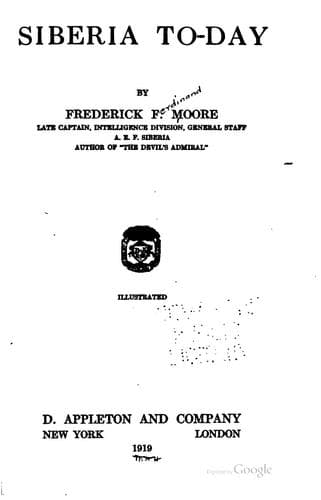
Siberia (Russia); Siberia (Russia) -- Description and travel
Neutrality, between right and wrong, is a crime. It was invented by
militaristic criminals who want to murder nations, and make sure that
there will be no interference by neighbors.
The thug, murdering his victim, resents the interference of the
passerby, by saying: “This is none of your business.” He demands
neutrality.
So it has become a virtuous act for a nation, when two nations engage
in war, to declare itself neutral. We realize now that something is
wrong in this system, so we have devised the league of nations idea.
This idea is nothing more than an agreement that there shall be no more
neutrality. If a nation threatens war, all the others agree to take
sides. The fact that all the others may combine against the aggressor,
or the nation adjudged to be in the wrong, automatically prevents the
war. Unless the aggressing nation feels strong enough to defy the
others, or able to accomplish its purpose of destruction before the
others can get into action.
But issues between nations are often beclouded, or the minds of peoples
are befogged, or populations become divided over what is right and what
is wrong. A league of nations, to operate according to the ideals of
the idea, presupposes the ability of peoples, or their leaders, to make
swift decision as to who is right and who is wrong. It calls for not
merely national statesmanship, but international statesmanship--which
is always for right.
We wanted to operate on the patient in Siberia but the doctors could
not decide whether to take out the appendix of Bolshevism, or cut off
the head that ached without a crown. The patient is still suffering
from a bad appendix--and a violent headache.
We said at home that Bolshevism menaced the world. It had ruined
Siberia. We were in Siberia with troops. We should have attacked
Bolshevism on its native heath, and declared to Russia and the world
that once the Bolshevists were whipped and knew they were whipped, we
would stand beside the nation till it had reorganized itself in its own
non-Bolshevist way.
Japan expected us to do those things, just as England did. We
practically forbade Japan from going into Siberia without our sanction,
or without us. We decried intervention or interference, and then
proceeded to intervene. I do not care what other term is used in
describing our landing an expedition in Siberia--it was intervention.
It was a measure for the safety of Russia, and for our own protection.
The minute our first armed man stepped upon the dock at Vladivostok, we
had intervened--we had interfered. It was our business to be effective,
to justify our presence there, to act in the manner we thought proper
and be responsible for our acts. All the others would have been glad to
coöperate with us, I am sure.
Public-domain text, read in full here on John Shaqi.
Reviews
Reviews
No reviews yet
Be the first to share your thoughts on this work.
Elsewhere in the archive
Join the Discussion
Join the discussion
Sign in to leave a comment or review.
Sign InorCreate an account